A bedroom ceiling is usually the largest uninterrupted surface in the room, yet it is often treated as invisible. That is changing. Current search data from Houzz shows growing interest in wallpapered, painted, and wood-clad ceilings, with homeowners using the “fifth wall” to create character without adding more furniture or clutter at eye level. In a bedroom, that idea can be especially effective because the ceiling is part of the view from the bed.
The challenge is proportion. A ceiling treatment can make a small bedroom feel more finished, but it can also make a low room feel compressed. It can add warmth to a neutral bedroom, or create visual noise directly overhead. This guide explains how to choose a bedroom ceiling idea that works with height, light, architecture, color, maintenance, and the way you actually use the room.
Why statement ceilings are gaining attention
Houzz’s 2026 UK Emerging Trends Report found strong year-over-year growth in searches for several ceiling treatments, including wallpapered ceilings, exposed wood beams, wooden ceilings, and painted ceilings. The broader direction is clear: people are looking above the walls for a place to add material, pattern, and architectural interest.
You can read the current search findings in the 2026 Houzz UK Emerging Trends Report. Haveliora’s approach is to translate that interest into bedrooms that remain restful and practical rather than treating every ceiling as a decorative opportunity.
First, identify the ceiling you actually have
Before choosing paint, wallpaper, paneling, or beams, study the room’s existing ceiling conditions. Is it flat and low? Tall and plain? Sloped? Vaulted? Broken by a soffit? Marked by a central light? Does it have vents, detectors, access panels, or a ceiling fan? These details determine what will look intentional and what will look like decoration wrapped around obstacles.
A low, flat ceiling usually benefits from continuity and controlled contrast. A tall ceiling can handle more texture and a stronger edge between wall and ceiling. A sloped ceiling often looks best when the treatment follows the geometry rather than pretending the slope is not there.

Painted ceilings: the lowest-commitment way to make a change
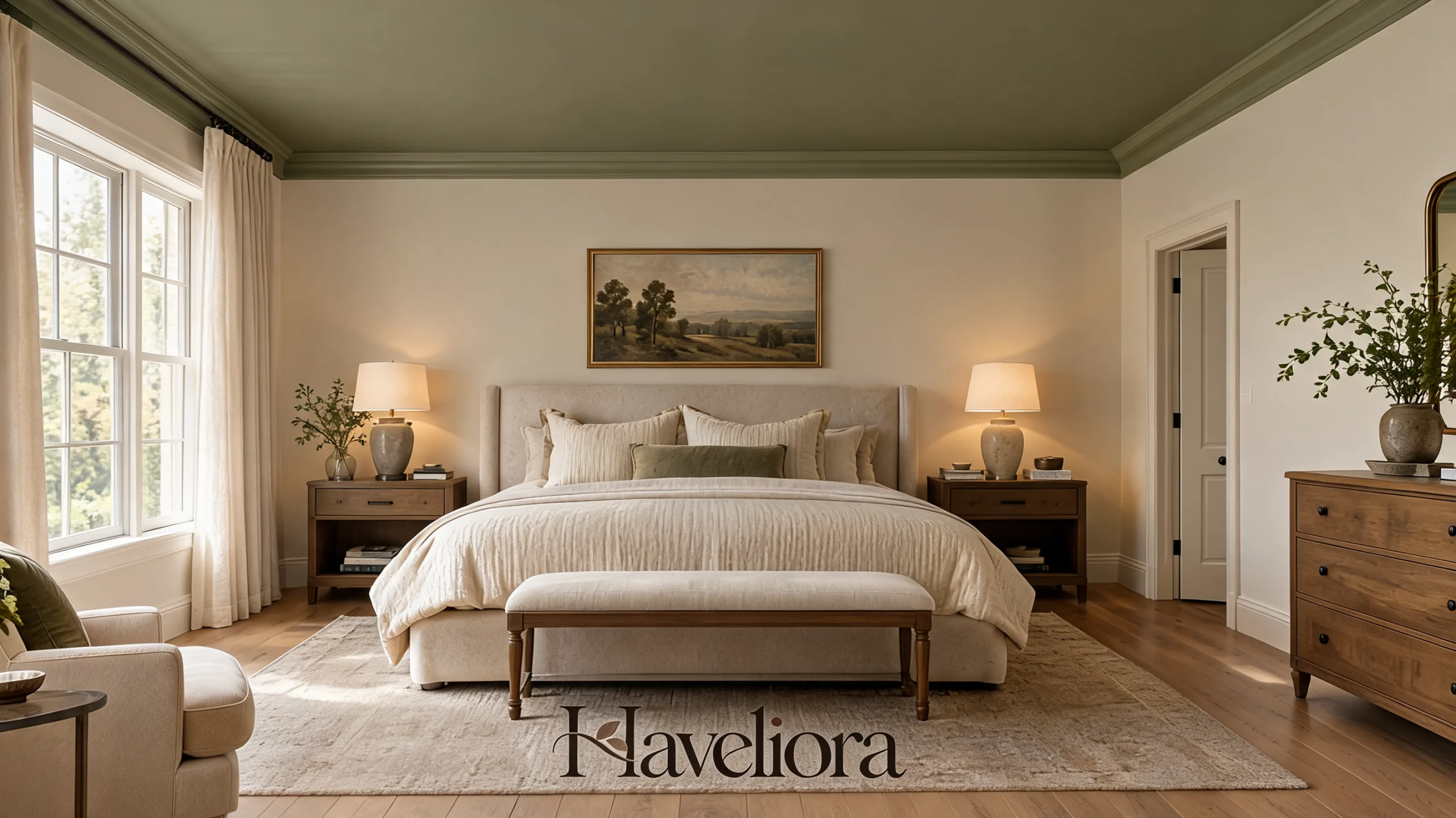
Paint is the most flexible ceiling treatment because it can alter the room’s proportions without adding physical depth. The simplest option is to continue the wall color overhead. This reduces visual breaks and can create a cocooning effect, particularly in a bedroom with medium or dark walls.
A lighter ceiling creates separation and can make the room feel more open. A darker ceiling lowers the perceived height and can make a tall room feel more intimate. The effect depends on contrast: a charcoal ceiling above white walls feels graphic, while a deep olive ceiling above sage walls feels more gradual.
If you already enjoy deeper bedroom palettes, Haveliora’s moody bedroom ideas explain how to balance dark color with practical light and softer materials.
Color drenching the ceiling and walls
Color drenching removes the bright white line that often separates walls from the ceiling. In a bedroom, that continuity can make awkward corners, low slopes, and small returns feel less fragmented. It is especially useful when the architecture is simple and you want the room to feel enveloping rather than decorated in layers.
Choose the finish carefully. A flat or matte ceiling usually minimizes surface imperfections, while walls may need a more washable finish depending on the paint system. Follow the manufacturer’s recommendations for compatibility and sheen.
Do not assume dark drenching always makes a room feel smaller. In some compact bedrooms, removing strong boundaries can make the geometry feel calmer. What matters is how much daylight the room receives and whether the furniture, bedding, and lighting introduce enough contrast to keep the space readable.
Wallpapered ceilings can be quiet or dramatic
Wallpaper overhead does not have to mean a busy floral. Fine stripes, clouded textures, small-scale botanicals, grasscloth-effect papers, and subtle geometrics can add a layer of detail that is visible from the bed but does not compete with every wall.
In a low bedroom, use a pattern with moderate contrast and avoid very large motifs that feel cut off by the room’s edges. In a tall bedroom, a larger repeat can help bring the ceiling visually closer. If the walls are already patterned, the ceiling paper should either be deliberately coordinated as part of a maximal scheme or much quieter. Accidental competition is the problem.
Installation overhead is more demanding than wallpapering a wall. Seams, adhesive, and gravity all matter, so a professional installer may be worth considering, particularly for expensive paper or large rooms.

Wood ceilings add warmth, but the direction matters
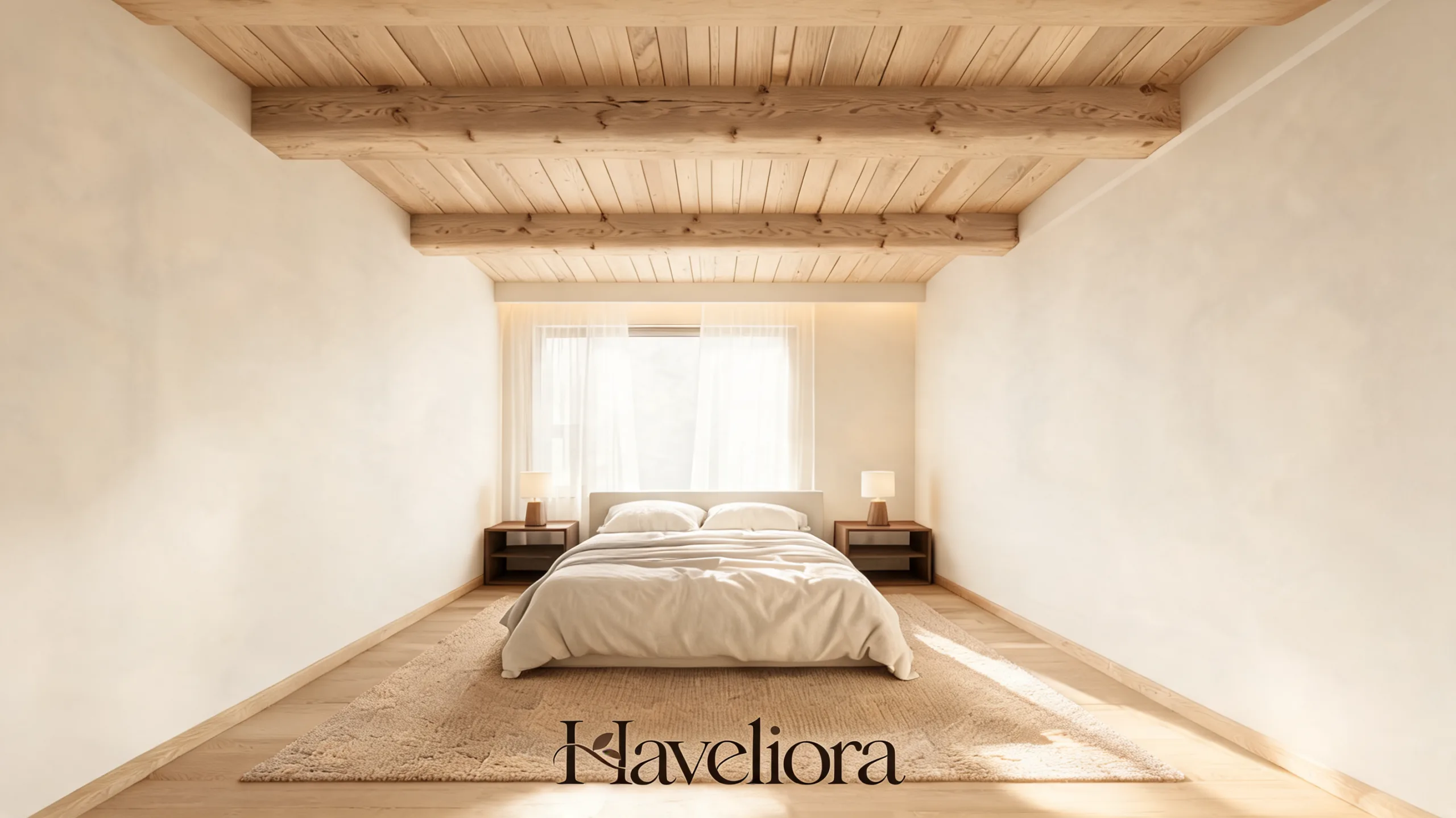
Timber boards, tongue-and-groove paneling, slats, and veneer systems can make a bedroom feel materially richer. Wood works particularly well when the room contains many soft, pale surfaces and needs an architectural counterweight.
Board direction changes the visual effect. Running boards along the longer axis can reinforce the room’s length. Running them across a narrow room can make the width more noticeable. On a sloped ceiling, following the slope usually creates the cleanest result.
Choose the wood tone in relation to the floor and furniture. Exact matching is not required. In fact, a slightly lighter ceiling often prevents the room from becoming too heavy. If the floor is very dark, a warm mid-tone or pale oak overhead can connect the palette without duplicating it.
For ideas on building warmth through material rather than color alone, Haveliora’s neutral bedroom guide is a useful companion.
Exposed or decorative beams
Beams can provide rhythm and scale, especially in tall or vaulted bedrooms. Existing structural beams should be treated as architecture, not simply painted to match a trend. Decorative beams can also work, but their size, spacing, and attachment need to be convincing and safe.
In a modest room, fewer substantial beams usually look better than many thin strips. A beam should appear to belong to the building. Randomly placed faux timbers can make the ceiling look busier without improving the room.
Do not attach heavy decorative elements to the ceiling without understanding the substrate and appropriate fixings. If the installation has meaningful weight, use a qualified professional.
Tray ceilings: use the recess as a separate layer
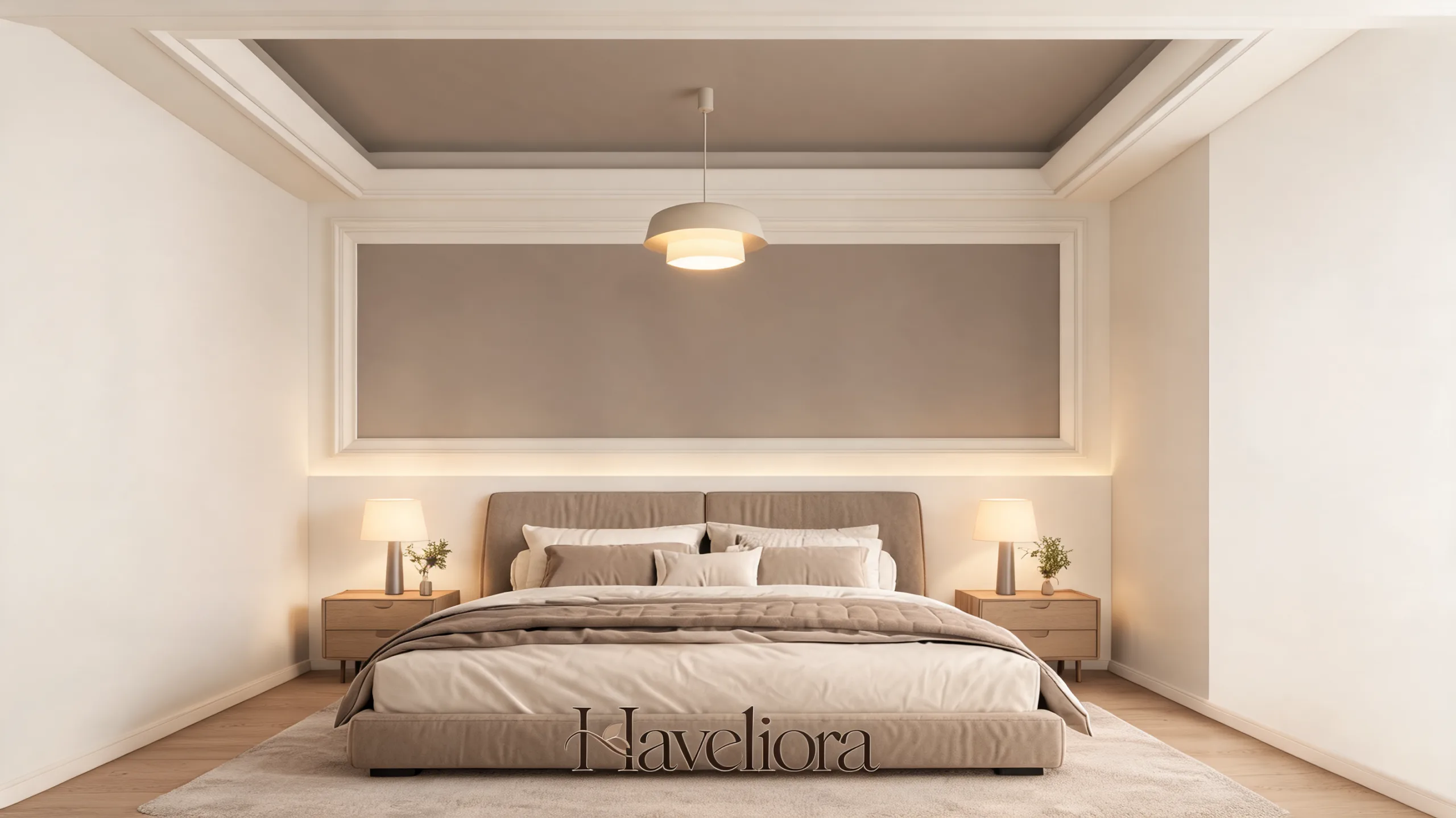
A tray ceiling already creates a natural boundary. You can emphasize the center with a deeper paint color, wallpaper, or wood while keeping the perimeter quieter. Another option is the reverse: keep the center pale and color the vertical tray edges to define the architecture.
Integrated lighting can be attractive, but avoid relying on hidden LED strips as the only light source. They create atmosphere, not necessarily good reading or dressing light. A bedroom still needs task lighting and controllable general illumination. Haveliora’s bedroom lighting guide explains how to layer those functions.
Sloped ceilings and attic bedrooms
Sloped ceilings often look fragmented when every surface is painted differently. Treating the slope as part of the wall or as part of the ceiling depends on the room, but consistency is usually more important than the rule itself.
If the slope comes down close to the bed, continuing the wall color over it can create a gentle enclosure. If the ceiling rises dramatically, a lighter upper plane can preserve height. Wallpaper can be effective on a single slope when it frames the headboard, but ensure the pattern alignment works across the angle.
In very small attic rooms, storage and movement are usually more important than the decorative treatment. Read Haveliora’s small bedroom ideas before committing to anything that visually reduces the usable zone.
Ceiling medallions and decorative plaster
A ceiling medallion can make a simple pendant feel connected to the architecture. It works well in traditional, new-traditional, and eclectic bedrooms, but scale is critical. A small medallion floating in a large ceiling can look incidental; an oversized ornate one in a low room can dominate the view.
If the room already has molding, use the profile and era of that trim as a reference. New decorative plaster should feel related to the architecture rather than added as a separate theme. This approach pairs naturally with Haveliora’s new traditional interior ideas, where classic details are balanced with fresher furniture and lighting.
Fabric on the ceiling: beautiful, but use with restraint
Fabric can soften acoustics and create a highly enveloping bedroom, especially when used with a canopy bed or in a tented treatment. However, it introduces cleaning, fire-safety, installation, and maintenance considerations that paint and wallpaper do not.
Do not drape ordinary fabric around recessed lights, heaters, smoke detectors, sprinklers, or electrical fixtures. A decorative concept must not obstruct life-safety devices or create heat buildup. For a true tented room, use materials and installation methods appropriate to the building and consult qualified professionals where necessary.
How ceiling treatment changes the apparent size of a bedroom
| Goal | Ceiling approach | Likely visual effect |
|---|---|---|
| Make a tall room feel more intimate | Darker or patterned ceiling | Brings the upper plane visually closer |
| Keep a low room open | Low-contrast pale paint or continuous wall color | Reduces visual interruption |
| Add warmth to a neutral room | Pale or mid-tone wood | Adds grain and material interest overhead |
| Make architecture feel more finished | Beams, molding, or tray emphasis | Clarifies the ceiling structure |
| Add pattern without using wall space | Wallpapered ceiling | Creates detail visible from the bed while walls stay calmer |
| Create a cocoon effect | Color-drenched walls and ceiling | Softens boundaries and increases enclosure |
Coordinate the ceiling with the headboard wall
The headboard wall and ceiling are usually the two strongest planes visible from the bed. They do not need to match, but they should relate. A patterned ceiling can pair with a plain upholstered headboard. A paneled headboard wall may need a simpler ceiling. If both surfaces are highly detailed, use a restricted palette so the room still has a clear hierarchy.
A useful test is to remove the small decor mentally. If the room still has one obvious focal relationship between bed, wall, and ceiling, the scheme is probably coherent.

Lighting should reveal the ceiling, not flatten it
A beautiful ceiling treatment can disappear under one harsh central light. Grazing light from wall sconces can emphasize timber grain or plaster texture. A pendant can help establish scale beneath a high ceiling. Dimmable ambient light makes deep paint and wallpaper feel richer in the evening.
For bedrooms with fans, check that any beams, decorative panels, or suspended elements maintain the manufacturer’s required clearances. Never compromise fan operation or safety for visual effect.
Maintenance and longevity
Ceilings are inconvenient to repair, so choose materials with long-term maintenance in mind. Matte paint hides minor surface flaws but can be difficult to wipe. Wallpaper seams can be vulnerable in humid conditions. Wood moves with changes in moisture. Textured plaster can be beautiful but more difficult to patch invisibly.
Before installing a decorative finish, resolve leaks, staining, cracks, or ventilation problems. A new surface should not be used to hide an active building issue.
Common bedroom ceiling mistakes
- Choosing a treatment before considering ceiling height. A dramatic idea can be wrong for the room’s volume.
- Ignoring fixtures and vents. The pattern or paneling should account for everything already on the ceiling.
- Using too many focal surfaces. A patterned ceiling, dramatic headboard, bold rug, and heavily patterned curtains can compete.
- Forgetting night-time lighting. Dark ceilings need layered light so the room remains comfortable after sunset.
- Covering a problem instead of repairing it. Stains and cracks may indicate issues that should be investigated first.
- Installing heavy elements without appropriate structure. Decorative beams and panels must be securely fixed.

How to choose a ceiling treatment by ceiling height
Ceiling height is the first filter because the same finish can behave very differently in two rooms. In a low bedroom, contrast is usually more noticeable because the ceiling occupies more of the field of view. A dark painted ceiling above bright walls can create a strong lid effect. That can be intentional in a snug room, but if the goal is calm rather than drama, a lower-contrast transition is easier to live with.
Medium-height ceilings give you the widest range of options. Paint, restrained wallpaper, shallow molding, slim timber boards, and modest medallions can all work if the rest of the room remains edited. The main question becomes visual hierarchy: is the ceiling meant to be the focal surface, or is it supporting a strong headboard wall, large window, or piece of art?
Very high ceilings often need more than a subtle color shift. They can absorb larger pattern, beams, a stronger pendant, or a darker tone without feeling compressed. The goal is not simply to make the ceiling noticeable. It is to bring the upper volume into proportion with the furniture so the bed does not look stranded at the bottom of the room.
Paint sheen matters more overhead than many people expect
A ceiling receives light at shallow angles, which makes surface imperfections visible in a different way than on a wall. Flat or matte finishes are usually the most forgiving because they minimize reflection across small patches, seams, and uneven plaster. That is one reason traditional ceiling paint is so often low-sheen.
If you are continuing a wall color onto the ceiling, resist the urge to use the exact same sheen automatically. A washable eggshell wall finish may be practical at hand level but too reflective overhead. Many paint systems allow the same color to be mixed in a flatter ceiling formulation, preserving the color-drench effect while reducing glare.
Glossy or lacquered ceilings can be striking in highly controlled rooms, but they reveal every irregularity and reflect windows, lamps, and moving light sources. The preparation standard is much higher. Unless the ceiling substrate is exceptionally smooth and the room benefits from reflected light, a lower sheen is usually the more durable decision.
Wallpaper scale should respond to the bed, not just the ceiling
When choosing wallpaper for a bedroom ceiling, look at the pattern from the position where it will be seen most often: lying or sitting on the bed. A motif that looks small on a sample card may feel much larger when repeated across the entire upper plane. Conversely, a tiny high-contrast repeat can become visually busy because the whole ceiling is visible at once.
Use the bed as a scale reference. A medium repeat that relates to the width of the headboard can create a more composed relationship than a pattern selected independently. If the headboard is highly detailed, choose a simpler ceiling paper. If the bed is plain and low, the ceiling can carry more pattern without forcing the rest of the room to compete.
Pattern direction matters as well. Stripes can reinforce the long axis of a narrow room, while a non-directional botanical or cloud-like print is more forgiving around irregular corners. In an attic bedroom, complicated directional papers can be difficult to align across changing slopes, so installation complexity should influence the design choice.
What to know before adding wood to a ceiling
Wood introduces real material depth, which means it affects more than color. Boards, battens, or panels add thickness and may interact with light fittings, vents, sprinklers, access panels, and ceiling heights. Before installation, understand the substrate and the attachment method rather than treating the ceiling as if it were a decorative wall.
Real wood also responds to humidity. Boards can expand and contract, and some species move more visibly than others. Proper acclimation, spacing, and installation methods matter. In rooms with existing moisture problems, the first priority is resolving the building issue rather than covering the ceiling with timber.
Veneer panels, engineered wood products, and high-quality wood-look alternatives can sometimes deliver the visual warmth with less movement or weight. The choice depends on budget, room conditions, and the level of authenticity you want. Whatever material you choose, avoid making the ceiling visually heavier than the floor unless that contrast is deliberate.
Beams should look structurally plausible
Decorative beams work best when their spacing and scale make architectural sense. A ceiling crossed by many narrow fake beams can look busier than the room needs, while a few well-proportioned elements can create rhythm and make a vaulted or wide bedroom feel more grounded.
Study where real structural loads would plausibly run. Even when the beams are purely decorative, aligning them with the room geometry, wall positions, or roof direction produces a more convincing result. Beams that stop randomly before a wall, collide awkwardly with a pendant, or sit too close to a fan tend to reveal themselves as applied decoration rather than architecture.
Weight and attachment are safety issues. Hollow decorative beams can be lighter than solid timber, but they still need appropriate fixings. If a beam installation involves meaningful weight or uncertain structure, use a qualified professional. The visual effect is not worth compromising the ceiling assembly.
How to handle vents, detectors, sprinklers, and access panels
A statement ceiling does not erase the room’s functional systems. Smoke detectors, sprinklers, air-conditioning vents, access hatches, speakers, and junction boxes may all be present, and they should remain accessible and unobstructed. Designing around them from the beginning is far better than treating them as inconvenient interruptions after the finish is selected.
Paint can usually integrate some devices visually without hiding them, but do not paint equipment that the manufacturer says should remain uncoated. Wallpaper should not bridge over removable covers or block sensing openings. Timber paneling may need carefully cut access points. Fire-safety and mechanical systems must continue to function as designed.
If the ceiling contains several visible components, a highly detailed pattern may make the result even busier. A restrained color treatment can often reduce visual fragmentation more effectively than adding another layer of decoration.
Statement ceilings in small bedrooms
A small bedroom can benefit from a stronger ceiling because it adds character without occupying floor space. The key is choosing a treatment that does not make the upper plane feel physically lower. Low-contrast paint, subtle wallpaper, or a continuous color-drench treatment often works better than thick beams or very dark high-contrast pattern.
Small rooms also reward simplicity in the rest of the design. If the ceiling carries pattern, keep window treatments relatively quiet and avoid stacking several competing accent walls. A strong ceiling plus a simple upholstered headboard can create more depth than trying to decorate every vertical surface.
Lighting becomes especially important. A small bedroom with a dark ceiling and one harsh central fixture may feel compressed at night. Bedside sconces, table lamps, and a small floor or dresser lamp can spread the light lower in the room and make the ceiling feel intentional rather than oppressive.
Statement ceilings in large bedrooms
Large bedrooms often suffer from the opposite problem: too much undifferentiated volume. A ceiling treatment can help the bed and seating areas feel connected to the architecture. Wood boards, beams, a darker paint color, or a larger wallpaper repeat can bring the upper plane visually closer without filling the floor with more furniture.
If the room contains a sitting area, use the ceiling to unify the whole space rather than creating unrelated zones above the bed and chairs. One continuous material or color can make the room feel cohesive, while furniture placement and rugs handle the functional separation below.
Large rooms also give you more freedom with pendants. A substantial light can mediate between the ceiling and bed, but it should not compete with an elaborate ceiling treatment. When both elements are strong, simplify one: a patterned ceiling may need a cleaner fixture, while a sculptural pendant may work best against a quieter surface.

How to coordinate ceiling color with flooring
The ceiling and floor form the two horizontal boundaries of the room. Looking at them together prevents the middle of the room from feeling disconnected. A dark floor and dark ceiling can create a highly enveloping box, which may be beautiful in a large, bright bedroom but heavy in a small room with limited daylight.
If the floor is warm wood, a painted ceiling can pick up one of the subtler undertones rather than matching the wood itself. Muted olive, warm taupe, soft clay, or creamy off-white can all relate to timber without turning the room monochromatic. With cool stone or gray flooring, introduce warmth through the ceiling only if bedding and furniture help bridge the temperature difference.
Wood on both floor and ceiling can work, but vary value or grain. A pale oak ceiling above a darker floor creates separation. Using the same wood tone on both surfaces can feel immersive, but it also demands careful lighting and enough quiet wall area to prevent the room from becoming visually dense.

How to plan lighting with a dark ceiling
Dark paint absorbs more light than white, so the lighting plan should be adjusted rather than assuming the same fixtures will perform identically. The goal is not to compensate by making the room extremely bright. It is to distribute light across several levels so the dark ceiling feels deliberate at night.
Bedside lamps or sconces provide task light. A dresser lamp or wall light can illuminate a second part of the room. A pendant or ceiling fixture can provide general light, but dimming is valuable because the ceiling may reflect or absorb light differently depending on finish. If there is a reading chair, give it its own source rather than depending on the fixture above the bed.
Warm light often complements deeper ceiling colors, but color temperature should also support the materials in the room. Test paint under the actual evening lighting before committing, because a ceiling color that looks balanced in daylight can shift considerably after sunset.
Repair first, decorate second
Ceilings reveal building problems. Water stains can indicate an active or previous leak. Repeated cracks may be cosmetic, but they can also signal movement that deserves investigation. Peeling paint may reflect poor preparation, moisture, or incompatible coatings. Covering these issues with wallpaper, panels, or fabric makes future diagnosis harder.
Before applying a new finish, identify the cause of visible damage and repair it properly. This is especially important with timber and wallpaper, which can conceal early signs of moisture. A decorative ceiling is only a good investment when the substrate beneath it is sound.
Old homes may also contain materials that require care during renovation. If you are uncertain about an existing coating, textured finish, or substrate, seek appropriate professional advice before sanding, scraping, or disturbing it.
Renter-friendly ceiling ideas
Renters have fewer permanent options, but the ceiling can still influence the room. The simplest strategy is to make the ceiling part of the composition without altering it: use tall curtains, a canopy bed, a strong pendant where an existing fitting allows it, or artwork and headboard scale that visually draw the eye upward.
Removable products marketed for ceilings should still be approached cautiously. Adhesives behave differently overhead, and removal can damage paint or plaster. Do not attach heavy decorative objects with temporary hooks simply because the product is removable. Gravity and load remain real constraints.
If painting is permitted, a reversible color change may offer the most impact. Confirm the lease requirements and whether the ceiling must be returned to its original color. A single coat of an approved darker or warmer shade can transform the room without adding physical material overhead.
A ceiling-treatment decision matrix
| If your priority is… | Consider | Think twice about |
|---|---|---|
| Lowest maintenance | Matte paint | Fabric or intricate molding |
| Maximum pattern | Wallpaper | Competing patterned walls |
| Natural warmth | Wood boards or veneer | Heavy timber in very low rooms |
| Architectural rhythm | Beams or molding | Random decorative strips |
| Renter flexibility | Paint if permitted, or visual framing from furniture | Heavy temporary ceiling attachments |
| Small-room character | Low-contrast color or fine pattern | Bulky beams and extreme contrast |
| Large-room intimacy | Darker paint, wood, larger pattern | A tiny isolated ceiling accent |
Before-you-buy checklist for a bedroom ceiling project
- Measure ceiling height and room dimensions. The finish should respond to the volume, not just the style you like.
- Map every ceiling device. Include fans, vents, detectors, sprinklers, lights, and access panels.
- Inspect the substrate. Resolve leaks, staining, peeling paint, or significant cracks first.
- Test color and pattern from the bed. That is the viewpoint that matters most in a bedroom.
- Plan lighting together with the finish. Dark paint, wood, and wallpaper can all change how the room reads at night.
- Consider maintenance. Ask how the material will be cleaned, repaired, or patched later.
- Check installation requirements. Heavy materials, electrical changes, and structural fixings may require qualified trades.
- Choose one dominant gesture. If the ceiling is strong, simplify at least one other major surface.
Which bedroom ceiling idea is right for you?
If you want the easiest reversible change, paint is the logical first step. If the room needs visual softness and pattern, wallpaper can add detail without consuming floor space. If the bedroom feels materially flat, wood can provide warmth and texture. If the architecture is tall or vaulted, beams may give it needed scale. And if the room already has strong molding or a tray, work with those features rather than covering them with a separate decorative concept.
The ceiling should improve the room even when you stop thinking of it as a trend. That is the best test of whether the idea belongs in the bedroom.
Other Articles

Conversation-Focused Living Room Ideas for Better Hangouts
Canopy Bed Ideas for a Modern, Cocooning Bedroom