

A small bedroom rarely needs every space-saving product advertised for it. More often, it needs a clearer decision about what belongs beside the bed, which doors must open fully, and where the objects you use every evening should go. A room can look generously furnished in a photograph and still be frustrating when you try to carry a laundry basket through it.
The small bedroom ideas in this guide put usable space first. They work with ordinary furniture and realistic layouts rather than assuming you can move walls or build custom cabinetry. Start with the bed and circulation, then address storage, light, and decoration in that order. A few well-chosen changes can make the room feel more settled without stripping away its personality.
Before moving anything, note the position of the door, windows, wardrobe, outlets, and heating or cooling equipment. Measure the full bed frame, not only the mattress. These fixed conditions are your design brief. An attractive idea is worth keeping only when it fits that brief and the way you actually live.
Explore the six ideas
1. Plan the Walking Route Before Choosing the Bed Position
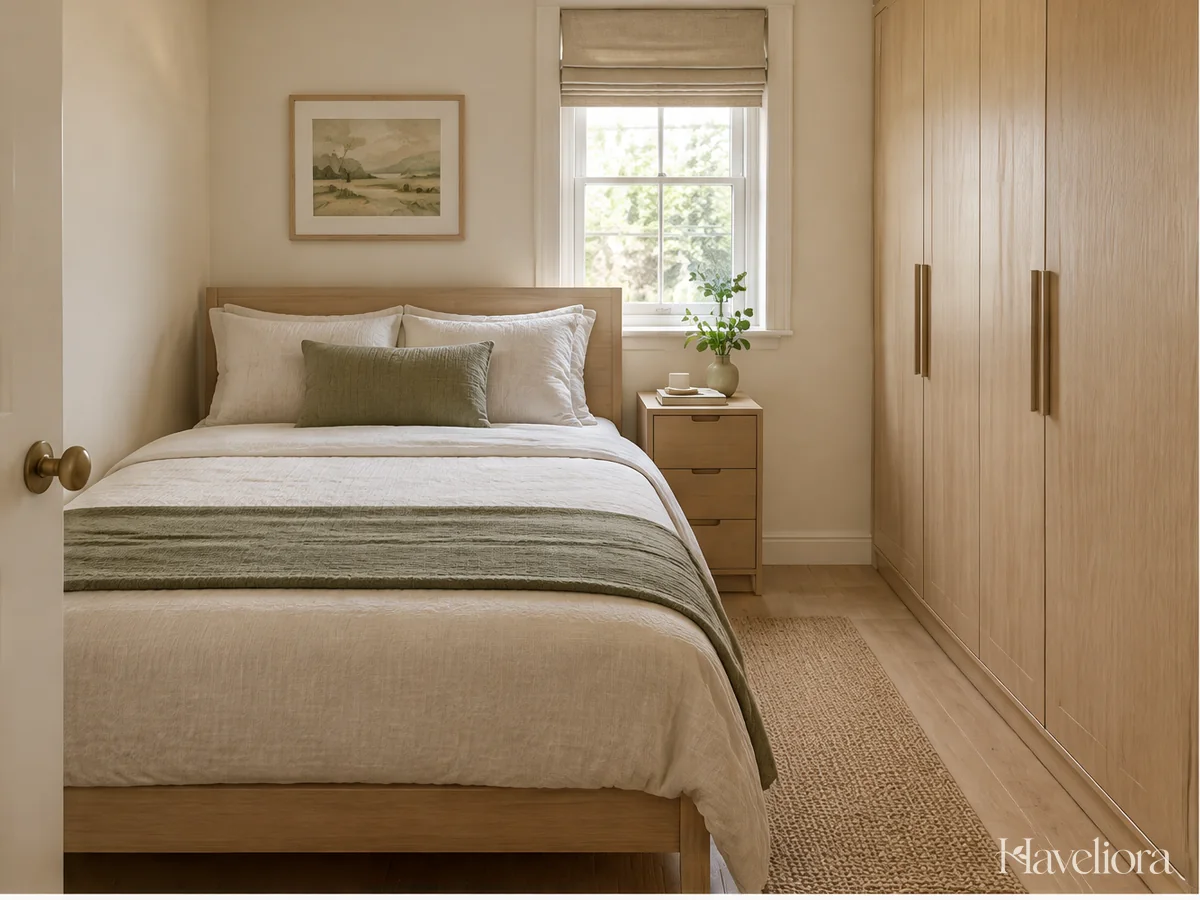
Start with the movements the room needs to accommodate. You need to enter, get into bed, reach your clothes, and open drawers. Arrange the bed so those tasks remain straightforward. The most symmetrical position is not automatically the most useful, especially when a wardrobe door opens into one side of the room.
Mark the bed’s complete footprint on the floor before replacing it. Include an upholstered surround, projecting headboard, and footboard. A mattress that fits comfortably can become a tight squeeze inside a deep frame. Compare two arrangements using removable tape and walk through each one rather than choosing from a floor plan alone.
For a shared bed, consider how both people get in and out. Pushing one long side against a wall may recover floor space, but it also changes everyday access. That trade-off may suit a guest room or occasional-use bed better than your main bedroom. Do not block a required exit window or reduce access to a heater to achieve a neater picture.
Make the decision concrete: write down your three non-negotiable functions. If dressing space matters more than a decorative bench, remove the bench from the plan early. A layout becomes much easier to resolve when every piece does not have equal priority.
2. Choose Bedside Furniture by What You Reach For
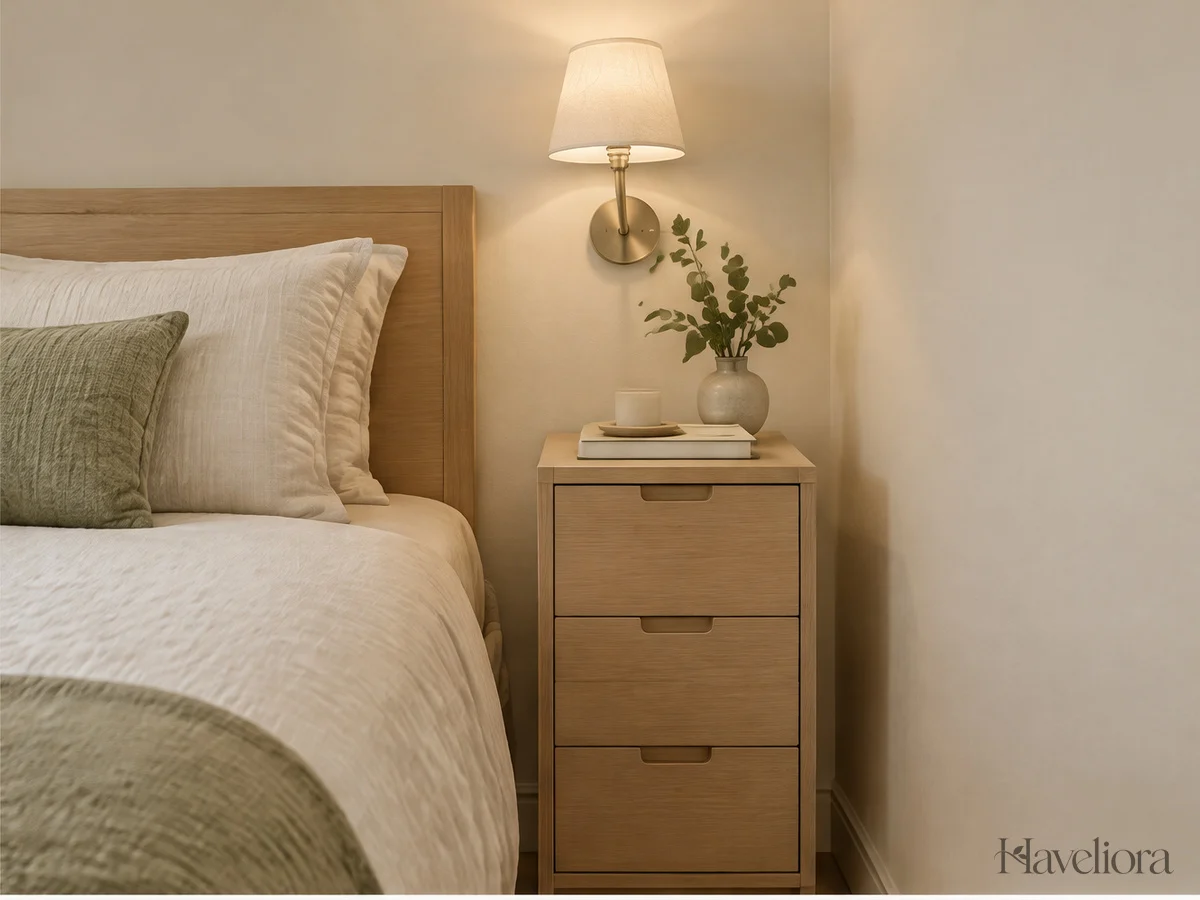
List the things you need at night: glasses, water, a book, a phone, or a lamp switch. The right bedside piece accommodates those objects without reaching across the mattress or placing a glass on the floor. A narrow cabinet with one drawer may solve more problems than a wider open table.
Check the tabletop height while sitting and lying in bed. An elegant low stool is not a good substitute when you cannot comfortably reach it. Depth matters as much as width; a shallow cabinet can preserve the route beside the mattress even if its front is relatively broad.
Wall-mounted lighting can release tabletop space, but it introduces installation and electrical considerations. Use a suitable fixture, follow the mounting instructions, and get qualified help when the installation requires it. A plug-in lamp remains a sensible option when its base fits the table and its cable can be routed safely behind furniture.
Two bedside pieces do not have to match. One side might need a closed cabinet while the other has room only for a shelf. Tie them together with a related finish or similar lampshades. This is often more convincing than forcing two identical bulky tables into a room that cannot support them.
Try before buying: use a box at the proposed height and depth for an evening. It will reveal reach and circulation problems that a product photograph cannot.
3. Count Storage You Can Open, Not Just Storage You Can Fit

A storage bed can be useful, but the mechanism must work within your layout. Side drawers need room to extend; an end drawer may conflict with a dresser; a lift-up base needs the manufacturer’s required operating space. Choose the mechanism after studying the surrounding furniture.
Give each storage area a category. Spare bedding belongs in one place, bags in another, and everyday clothing where it is easiest to reach. Mixed containers filled with unrelated objects may hide clutter without making the room easier to maintain. Keep less frequently used items in the least convenient locations.
Measure the opening of wardrobes and drawers as well as their external dimensions. A bedside table that prevents the wardrobe door from opening fully can turn a large cupboard into awkward storage. Sometimes moving a table or changing the way a category is stored is more effective than adding another unit.
Keep safety in mind when choosing tall or narrow furniture. The CPSC’s Anchor It guidance recommends securing furniture and televisions according to their instructions. A narrow footprint does not remove tip-over risk.
A useful test: retrieve your most frequently used items with the room arranged normally. Anything that requires moving two other objects needs a better position or a different storage method.
4. Let the Window Keep Its Useful Space

Heavy fabric is not inherently wrong in a small bedroom, but bulky folds can crowd a narrow window. Choose a treatment that provides the privacy and light control you need without collecting unnecessarily around the bed or floor.
Where the wall allows it, let open curtain panels sit mostly beside the glass. Measure the finished drop from the planned rod or track, accounting for the heading. A hem that just clears the floor is easier to manage than a long puddle in a tight route.
Consider the daytime and nighttime requirements separately. A sheer may filter daylight beautifully yet fail to provide enough privacy after dark. A discreet shade paired with a lighter decorative panel can address both needs. In some rooms, a simple lined blind is more practical than full-length curtains.
Keep access to window handles, ventilation, and any required escape opening clear. Do not let fabric cover heating equipment or obstruct floor vents. An attractive window arrangement should still function when you need to open, close, or clean it.
For a calmer outline: choose curtains close to the wall color, then introduce a stronger accent through bedding. This puts the visual focus on the bed rather than making every edge of the room compete.
5. Use a Mirror to Improve a View, Not Fill a Gap
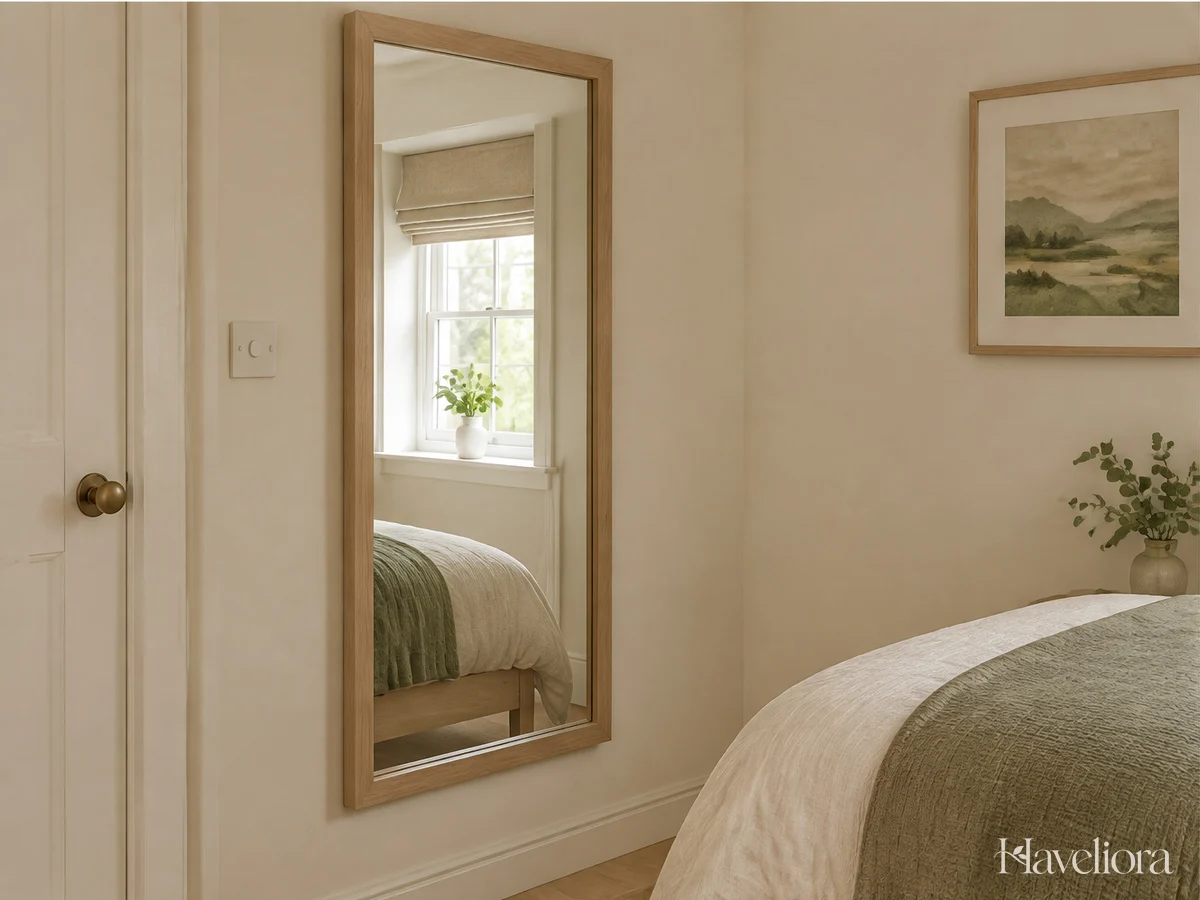
A mirror can add another view to a small room, but it will reflect whatever you place opposite it. A window or a simple wall may contribute to the atmosphere; overflowing shelves and laundry will simply become more noticeable. Check the reflection before choosing the frame.
Decide whether the mirror is mainly for dressing or decoration. A full-length mirror needs a position where you can stand far enough back to use it. A mirror over a dresser may support a decorative arrangement but will not necessarily meet that practical need.
Test the position from the doorway, bed, and dressing area. Look for direct glare from a lamp or an awkward reflection of a bright fixture. A mirror is not a substitute for adequate lighting, and placing one on every available wall is unlikely to solve a crowded layout.
Follow the mounting or restraint instructions for the particular product. A mirror styled to lean still needs appropriate securing when specified. The relaxed appearance should come from the design, not from leaving heavy glass unstable.
Keep it proportionate: a simple frame often works best when the reflected scene already contains plenty of detail. Let the mirror support the room rather than introduce another demanding focal point.
6. Reduce Visual Competition Without Removing Personality

A small bedroom does not have to be all white. What often helps is making the largest surfaces feel related. Try a limited group of colors across the walls, bedding, and curtains, then use a small accent to provide character.
For example, an ivory wall, oatmeal bed, and cream curtain can support a sage throw and one meaningful piece of art. The shades need not match exactly. Variation in weave, grain, and texture can create interest without requiring a different color on every object.
Arrange surfaces around the way you actually use them. Leave enough clear space on the dresser to put something down, and choose one or two display locations rather than distributing small decorations everywhere. A personal object is easier to appreciate when it is not hidden among many others.
Avoid interpreting simplicity as a demand to replace everything you own. Keep the furniture that works, then connect it through a repeated tone or material. A darker inherited cabinet can become part of the scheme when a frame or textile echoes its color elsewhere.
Finish with one question: does this item add comfort, storage, or something personally meaningful? If it does none of those things and makes movement harder, the room may be better without it.
A Small-Bedroom Refresh You Can Test Before Spending
Start with a no-purchase trial. Clear one route, empty the bedside surface, and remove a piece that is not essential. Live with the arrangement for several days. Notice whether the missing furniture was genuinely useful or simply familiar.
Next, choose the single improvement with the clearest benefit. That might be a shallower bedside cabinet, curtains that fit properly, or storage that opens without moving the bed. Buy for the specific problem rather than purchasing several unrelated space-saving accessories.
Keep a short set of measurements on your phone: the full bed dimensions, available bedside width, wardrobe swing, and the width of your main walking route. Add photographs taken from the doorway. These references make it easier to judge furniture while shopping and reduce the temptation to choose by appearance alone.
Frequently Asked Questions
Should I push the bed against the wall?
Sometimes, but consider who uses it and how often. A single sleeper may accept one-sided access, while two people may find it inconvenient. Test making the bed, changing sheets, and getting up at night before treating recovered floor space as an automatic improvement.
Does a small bedroom need small furniture?
It needs furniture that fits its functions and routes. Several tiny pieces can create more clutter than one useful cabinet. Compare the total footprint and storage capacity, and prioritize the bed and everyday access before filling remaining gaps.
What should I change first?
Fix the most frequent frustration. A blocked drawer, unreachable lamp, or pile of clothes usually deserves attention before wall decoration. Once the room works, use our cozy bedroom guide for additional texture and comfort, or explore neutral bedroom color combinations.
A successful small bedroom is not the one containing the most clever furniture. It is the one where the useful pieces have enough room to work and the decorative details feel chosen rather than squeezed in.
Other Articles

Neutral Bedroom Ideas for a Calm, Layered Look
21 Cozy Bedroom Ideas for a Warm and Relaxing Space