

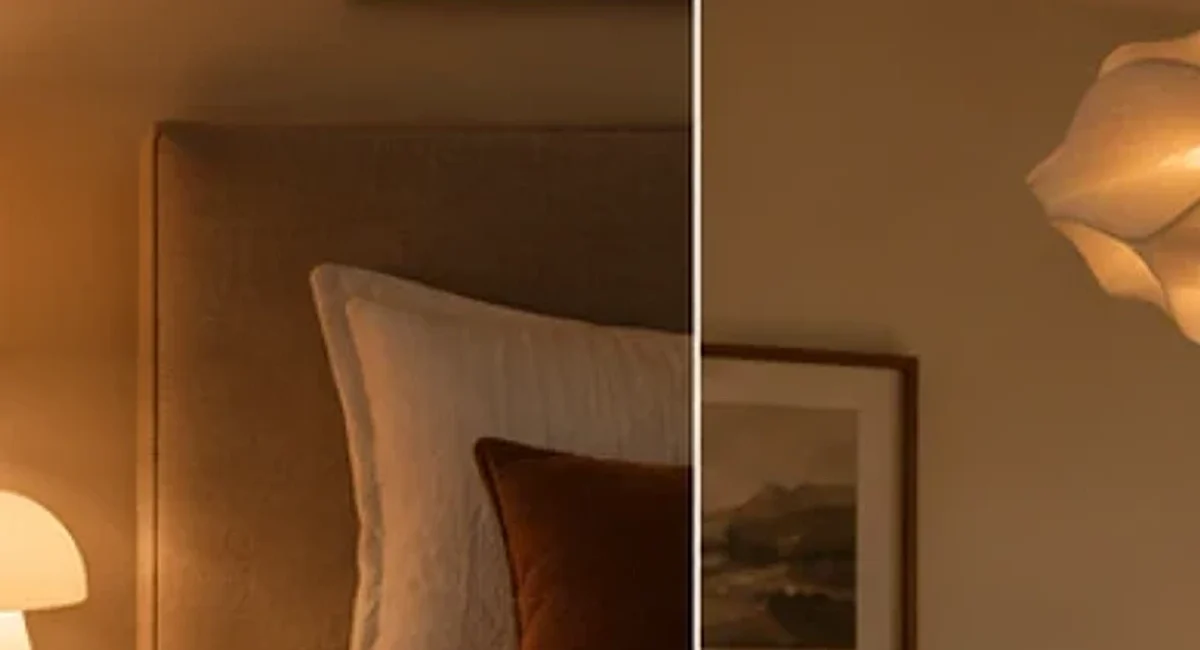
Bedroom lighting is easy to underestimate because many rooms begin with a single ceiling fixture and two bedside lamps. That setup can work, but it often leaves the room either too bright or too dim, with very little in between. A better bedroom lighting plan gives you several levels of light for different moments: getting dressed, reading, winding down, moving through the room at night, and simply making the space feel comfortable after sunset.
The goal is not to install as many fixtures as possible. It is to put light where you actually need it and avoid asking one source to do every job. A ceiling light can provide broad illumination, but it may not be pleasant for reading in bed. A tiny bedside lamp may create atmosphere, but it may not help when you are looking for clothes. A good plan allows these sources to support one another.
Lighting has also become a more visible part of interior design in 2026. Recent coverage has emphasized layered lighting, decorative shades, natural materials, portable lamps, and fixtures with enough character to act as part of the room’s design rather than disappearing into the background. That broader direction is useful, but function still comes first. The best bedroom lighting ideas are the ones that make your nightly routine easier while improving the way the room looks.
If you are updating the room more broadly, you may want to pair this guide with our cozy bedroom ideas, moody bedroom ideas, or fall bedroom ideas. Those articles deal with color, texture, and layout; this one focuses on the light itself.
1. Build the Room Around Layers of Light, Not One Big Fixture

Think of bedroom lighting in layers. The first layer is general light—the source that lets you see the room as a whole. The second is task light, which supports a specific activity such as reading, dressing, or applying makeup. The third is accent or ambient light, which creates visual comfort and helps the room feel softer in the evening.
Not every bedroom needs a separate fixture for each layer. A well-positioned bedside lamp can provide both task and ambient light. A ceiling pendant with a diffuser can provide broad light without feeling harsh. A small dresser lamp can illuminate a dark corner while also becoming a decorative detail. What matters is that the room gives you more than one lighting condition.
Start by observing how you use the room after sunset. Walk through your normal routine without changing anything. Where do you struggle to see? Where is the light too strong? Which switches are inconvenient? Do you turn on the ceiling light simply because nothing else is bright enough? Do you read using a lamp that creates glare or shadows? These observations are more useful than choosing fixtures from a mood board.
Once you know the tasks, assign a source to each one. The bed may need a focused light. The wardrobe may need broader illumination. A chair may need a reading lamp. A dresser may only need a small warm lamp for evening atmosphere. You can then decide which fixtures can serve more than one purpose.
Layering also makes the bedroom easier to adapt throughout the day. You may use general light early in the morning, task light while getting ready, and only the lowest ambient sources before sleep. That flexibility is what makes the room feel thoughtfully lit rather than simply bright.
2. Get Bedside Lighting at the Right Height and Distance

Bedside lighting should be designed around the person using the bed, not around a decorative rule. The right height depends on the mattress, headboard, table, fixture, and whether the light is used for reading. A lamp that looks perfectly proportioned in a photograph may cast light into your eyes or leave the page in shadow when you are actually in bed.
If you use table lamps, sit in your normal position before deciding on height. The shade should block direct glare from the bulb while allowing useful light to reach the bed. A lamp that is too low may illuminate only the nightstand; one that is too high may expose the bulb or create uncomfortable glare. The easiest test is practical: place the lamp or a temporary light source where you intend to use it and read for ten minutes.
Wall sconces are useful when bedside tables are narrow or when you want to free the surface for books, water, glasses, and other essentials. Plug-in sconces can be a lower-commitment option than hardwired fixtures, especially in rentals or rooms where electrical work is not planned. Swing-arm designs can help direct light toward a book without illuminating the entire room.
Pendant lights beside the bed can also work, but they require careful placement. The cord, shade, and hanging height should not interfere with getting in and out of bed or making the bed. A decorative pendant may look dramatic, yet if the switch is across the room it may be less useful than a simple bedside lamp. Control matters as much as appearance.
For shared bedrooms, separate controls are especially valuable. Each person should be able to use their bedside light without forcing the other side of the room to be equally bright. This is one of the strongest arguments for two smaller sources rather than one central reading light.
3. Choose a Ceiling Fixture That Supports the Room Instead of Dominating It

The ceiling fixture is often the first thing people think about when they update bedroom lighting, but it should not automatically become the strongest element in the room. A pendant, flush mount, semi-flush fixture, or ceiling fan light should provide enough general illumination while respecting ceiling height, furniture placement, and the visual weight of the bed.
Low ceilings usually benefit from fixtures that stay closer to the ceiling plane. A shallow flush mount can still have character through material, shape, or texture. Higher ceilings allow more drop, but the fixture should not hang so low that it competes with the headboard or obstructs circulation. Scale it to the room rather than choosing the largest fixture that fits.
Material can change how the light feels. Fabric, paper, opal glass, woven fiber, and frosted shades diffuse light differently from exposed bulbs or clear glass. If the ceiling light is used frequently, a diffused fixture can be easier on the eyes than a very bright visible bulb. If the fixture is primarily decorative and other lamps handle evening light, you may have more freedom to choose a sculptural design.
Recent 2026 design coverage has highlighted natural-material fixtures and softer sculptural forms, including fiber shades and more characterful pendants. That is a useful direction because texture can make a central fixture feel warmer without requiring ornate decoration. Still, choose the fixture for your room first. A woven pendant in a tiny bedroom with many other textured surfaces may feel too busy, while the same fixture can provide exactly the softness a clean-lined room needs.
If you use a dimmer, make sure the bulb and fixture are compatible with dimming. Do not assume every LED will behave smoothly on every dimmer. Check the product specifications before installation, especially when upgrading an older switch.
4. Add a Portable or Dresser Lamp for the Lowest Evening Layer

A bedroom often becomes more comfortable when the light is distributed beyond the bedside tables. A small lamp on a dresser, shelf, chest, or console can soften a dark corner and create a low evening layer that feels less functional than the main fixtures. It can also balance the room visually, especially when both bedside lamps are concentrated on one wall.
Portable rechargeable lamps make this easier because they do not need to sit next to an outlet. They can be moved between a dresser, shelf, or reading corner and can provide a low pool of light without another visible cable. Their brightness varies widely, so treat them as accent sources rather than assuming they can replace proper task lighting.
The lamp itself can be small. In fact, a compact fixture often works better on a dresser because it leaves usable surface area for clothing, jewelry, or storage. Choose a shade that directs some light outward or downward rather than a fixture that shines a bright point directly into the room.
Consider what the lamp illuminates. A warm glow on a textured wall, artwork, wood surface, or ceramic object can create more visual depth than a lamp placed in front of a mirror where the light may reflect harshly. The surrounding materials become part of the lighting effect.
This is also a good place to introduce a decorative shade or material you would not necessarily use at the bedside. A pleated shade, colored glass base, ceramic lamp, or small metal fixture can add personality without becoming the room’s dominant feature. Because the source is secondary, you can be slightly more playful.
5. Create a Reading Zone With Light That Actually Reaches the Page

A bedroom reading corner does not need a large amount of space, but it does need useful light. An armchair in a corner can look inviting during the day and become frustrating at night if the nearest lamp is behind the chair or too far away. Place the light where it reaches the page without creating glare in your eyes.
Floor lamps are practical because they do not require another table. A directional shade or adjustable arm can focus light on the book, while a shaded floor lamp can provide a broader pool of illumination. If you use a table lamp, make sure the table is high enough and close enough that the light is not blocked by your shoulder.
Reading light does not have to be extremely cool or bright. The better question is whether you can read comfortably without straining and without forcing the rest of the room to be fully illuminated. The FTC advises shoppers to compare bulbs by lumens for brightness rather than watts, because wattage measures energy use rather than light output. The Lighting Facts guidance from the FTC also explains that bulb packaging includes information about light appearance, helping you compare warmer and cooler options.
If you read in bed rather than in a chair, the same principles apply. The light should be close enough to the page to be useful, shielded enough to avoid glare, and independently controlled if another person shares the room. A wall-mounted reading light can be particularly effective when space is limited.
The chair itself should also justify the lighting. Do not add a reading lamp to a corner that you never use simply because the composition looks complete. If the chair becomes a place for clothing rather than reading, the lamp may be better used beside a dresser or desk.
6. Design the Room for the Last Hour Before Sleep

The most important bedroom lighting may be the lighting you use immediately before sleep. At that time, the goal is usually not maximum brightness. You need enough light to move safely, put things away, read, prepare for bed, and see what you are doing without turning the room into a workspace.
Create an evening sequence. Perhaps the ceiling light is used while you change clothes, then switched off. The bedside lamps and dresser lamp take over. Later, only one bedside source remains. This does not require smart-home automation; it can be as simple as placing switches and lamps where the sequence feels natural.
Warm light is commonly used in bedrooms because it creates a softer visual atmosphere. The U.S. Department of Energy describes lower correlated color temperatures as warmer in appearance and notes 2700K and 3000K as common warm choices for homes. Rather than treating a number as a strict rule, use it as a reference and judge the bulb in your actual room. Wall color, shade material, and fixture design all influence how the light appears.
Keep the final light easy to control from bed if possible. Getting up to cross the room and switch off the last lamp defeats some of the comfort you worked to create. A bedside switch, plug-in remote, compatible smart plug, or fixture with an accessible control can solve that practical problem.
Nighttime navigation also deserves attention. If you regularly wake during the night, consider a very low source near the floor or along the route you use. The aim is not to illuminate the entire room, but to avoid turning on a bright ceiling fixture. Make sure any night light is positioned so it does not shine directly at the bed.
How Bright Should Bedroom Lighting Be?
There is no single brightness level that suits every bedroom because room size, wall color, age, visual needs, fixture design, and task all matter. A dark room absorbs more light than a pale one. A shaded lamp delivers light differently from an exposed bulb. A reading light has a different job from a decorative dresser lamp.
Use lumens as the starting point when buying bulbs rather than relying on wattage. The FTC and ENERGY STAR both explain that lumens describe brightness while watts describe energy use. If you are replacing an old bulb, the package can help you compare equivalent light output. Then adjust based on the fixture and how the room feels.
Instead of trying to make every source equally bright, give each one a job. General light can be brighter because it serves the whole room. Bedside reading light should be focused. Accent light can be lower. This creates a room that feels layered even when the total number of fixtures is modest.
What Color Temperature Works Well in a Bedroom?
Color temperature is measured in Kelvin, and lower values appear warmer while higher values appear cooler. Warm white light around the lower end of common residential ranges is often used in bedrooms because it complements wood, fabric, and warmer paint colors. Cooler light can be useful for some tasks, but mixing very different color temperatures within one small room may make the lighting feel inconsistent.
If your room uses mostly warm materials, test a warm bulb first. If the palette is cooler or you need a clearer task light at a desk, you may prefer something slightly more neutral for that specific fixture. The important point is not to choose by label alone. “Soft white,” “warm white,” and similar terms can vary by manufacturer, so check the Kelvin value on the package.
Also pay attention to how the bulb renders the colors you care about. Bedding, wall paint, wood, and artwork can look noticeably different under different light sources. If you are making an expensive paint or textile decision, view the sample under the bulbs you actually plan to use.
Bedroom Lighting Ideas for Small Rooms
Small bedrooms benefit from fixtures that do more than one job. A wall sconce can free the bedside table. A ceiling fixture can provide broad light without using floor area. A portable lamp can move between a dresser and reading corner. The aim is to reduce physical clutter while preserving several layers of light.
Use the walls and headboard area strategically. Plug-in sconces can add bedside light without electrical work, and slim picture lights can illuminate art or shelving. Avoid placing large floor lamps in the main circulation path simply because there is an empty corner.
Mirrors can amplify the visual effect of light, but check the reflection. A mirror opposite a lamp can create glare or expose the bulb. Position it so the reflected scene is useful and calm. In a very small room, one well-placed mirror may be enough.
If you need more layout help, our guide to small bedroom ideas covers bedside space, storage, furniture scale, and circulation in more detail.
Rental-Friendly Bedroom Lighting Upgrades
You do not need to rewire the room to improve it. Plug-in wall sconces, table lamps, floor lamps, rechargeable lights, corded pendants designed for plug-in use, and smart plugs can all change the lighting plan without permanent electrical work.
Start with the switches you already have. If the overhead fixture is harsh, a better bulb or shade may improve it. If the bedside table is crowded, replace the table lamp with a plug-in sconce. If the dresser corner is dark, add a small portable lamp. These changes can be reversed when you move.
Use cable management carefully. A cord running across a walking path is not an acceptable tradeoff for better lighting. Keep cords against walls, use appropriate clips or channels where permitted, and follow the fixture manufacturer’s instructions.
Common Bedroom Lighting Mistakes
The most common mistake is asking the ceiling fixture to do everything. The second is choosing lamps for symmetry without checking whether they are useful from bed. Another is placing beautiful fixtures where the bulb is visible from normal eye level, creating glare.
Mixing wildly different color temperatures can also make the room feel disjointed. A cool white ceiling light beside very warm amber lamps may make the wall color appear to change from one part of the room to another. You do not need exact matches, but the sources should feel related.
Finally, avoid buying fixtures before measuring. Check bedside table depth, headboard height, ceiling height, door swings, and walking routes. A fixture that fits visually may still interfere physically.
A Simple Bedroom Lighting Plan You Can Use
For a typical bedroom, begin with one general source, one light on each occupied side of the bed, and one optional secondary source away from the bed. That secondary source might be a dresser lamp, floor lamp, or reading lamp depending on the room. If the wardrobe area remains dark, address that separately rather than increasing the brightness of every other fixture.
Then decide how the sources are controlled. The ideal plan minimizes unnecessary walking and lets you reduce the light gradually during the evening. A beautiful scheme with inconvenient controls will not feel luxurious for long.
Live with the arrangement for a week before adding more. Notice which lights you actually use. You may find that three well-placed sources are enough, or that one task area still needs help. Let use determine the final layer.
Frequently Asked Questions
Is warm or cool light better for a bedroom?
Warm light is commonly preferred for the relaxed evening atmosphere of a bedroom, while slightly more neutral light may suit specific tasks. Check the Kelvin value rather than relying only on marketing labels, and test the bulb with your wall color and textiles.
Are wall sconces better than bedside lamps?
Neither is universally better. Sconces save table space and can direct light effectively, while table lamps are easier to move and replace. Choose based on bedside space, reading habits, installation options, and where you want the switch.
How many lamps should a bedroom have?
Use as many as the room needs, not a fixed number. Many bedrooms work well with two bedside sources plus one general source and an optional dresser or reading lamp. Larger rooms may need more; small rooms may need fewer.
What should I look for when buying a bulb?
Check brightness in lumens, light appearance or color temperature, wattage or energy use, dimming compatibility if needed, and whether the bulb is suitable for the fixture. The FTC Lighting Facts information on packaging is designed to make those comparisons easier.
Can I mix lamp styles in one bedroom?
Yes. They do not need to be a matching set. Connect them through one or two common qualities such as material, shade color, metal finish, or overall visual weight. A room often feels more personal when fixtures relate without being identical.
How can I improve bedroom lighting without an electrician?
Use table lamps, floor lamps, plug-in sconces, rechargeable portable lights, smart plugs, and compatible bulbs. If electrical work is required for a hardwired fixture, use a qualified professional and follow local requirements.
How to Measure Before You Buy a Bedroom Light
Lighting mistakes are often measurement mistakes. A bedside lamp may be attractive but too deep for the table. A wall sconce may sit exactly where the headboard needs to be. A pendant may look elegant in isolation but hang into the sightline of someone sitting in bed. Taking a few measurements before shopping prevents these problems.
For bedside lamps, record the height of the mattress from the floor, the height and depth of the nightstand, the width available beside the bed, and the height of the headboard. Then sit in bed and note where your eye level falls. You want the shade to shield the bulb from that normal position while still allowing light to reach the book, table, or floor area you care about.
For wall sconces, mark the proposed position with painter’s tape before drilling. Sit, lie down, reach for the switch, and make the bed. Check whether the arm or shade interferes with pillows, artwork, or the headboard. If the fixture swings or pivots, test the full range rather than only its resting position.
For pendants, consider both height and width. A broad shade may need more clearance than a narrow one, and the cable or stem should not fall into a route where you naturally move. If the pendant is beside the bed, make sure it does not hang where you lean when getting up. If it is central, check clearance from tall furniture and whether it visually crowds the headboard.
These checks are simple, but they make the finished room look more deliberate because the fixtures appear to belong to the furniture rather than merely occupying available electrical points.
Table Lamps, Sconces, Pendants, or Floor Lamps: Which Is Right?
Table lamps are the most flexible choice. They are easy to move, easy to replace, and available in almost every style. They work best when the nightstand has enough depth and the lamp can sit without competing with essentials. Their main limitation is surface space.
Wall sconces free the nightstand and can make the bed wall feel more architectural. They are especially useful in small rooms or where you want a cleaner bedside surface. Plug-in versions reduce installation demands, while hardwired sconces create the neatest appearance when electrical work is appropriate.
Pendants can make a strong visual statement and also free the table, but they are the least forgiving if positioned poorly. Because they hang from above, they require careful coordination with the bed and ceiling. They are most successful when the drop is planned around real use rather than chosen only for symmetry.
Floor lamps are excellent for reading corners and can also brighten a dim side of the room. Their drawback is floor space. In a compact bedroom, a floor lamp should earn its footprint by serving a real task. In a larger room, it can create a secondary zone away from the bed and make the lighting feel more complete.
There is no reason every fixture in the room must come from the same collection. A ceramic bedside lamp, metal floor lamp, and woven ceiling pendant can coexist if their proportions and colors make sense together. Matching everything exactly can sometimes make the room feel more like a showroom than a home.
A Smarter Way to Shop for Bedroom Bulbs
Start with brightness. As the FTC explains, lumens indicate how much light a bulb produces, while watts indicate energy use. If you are replacing a bulb that feels too dim or too bright, compare lumens rather than assuming a different wattage will create the result you want.
Then check color temperature. Lower Kelvin values appear warmer; higher values appear cooler. For a bedroom, many people prefer warm light for evening use, but the exact choice should support the task and the room. A reading lamp may need enough clarity to make text comfortable, while a small dresser lamp may be chosen primarily for atmosphere.
Check dimming compatibility if the fixture is on a dimmer. The bulb, driver, and dimmer all need to work together. If you hear buzzing, see flickering, or find that the bulb drops out before reaching a useful low level, the components may not be compatible.
Finally, consider the physical bulb. Some decorative fixtures expose the bulb, making its shape part of the design. Others have narrow shades or enclosed spaces that limit which bulbs fit. Read the fixture specifications rather than assuming a standard bulb will always work.
How to Edit Bedroom Lighting After Installation
Once the fixtures are installed, resist the urge to add more immediately. Use the room for several nights. Notice which switches you reach for, where shadows remain, and which source is too strong. Lighting is easier to evaluate through routine than through a single reveal.
If the ceiling light is rarely used, that may be fine; it can still be valuable for cleaning and getting dressed. If a bedside lamp is always left off, ask whether the switch is inconvenient, the light is too bright, or another fixture already does its job. If a dresser lamp is decorative but never improves the room, move it to a place where it illuminates something worth seeing.
The final plan should feel simple in use even if several sources are involved. You should not need to walk around the room switching off five unnecessary lamps every night. Keep the fixtures that create meaningful differences and remove or relocate the ones that do not.
Final Thought
The best bedroom lighting plan gives you choices. It lets you see clearly when you need to, read comfortably, move safely, and reduce the room to a softer glow when the day is ending. Start with the activities rather than the fixtures, layer several useful sources, and make the controls easy to reach. When lighting works with the bed, furniture, color, and routine, the whole bedroom feels more considered—even before you change anything else.
Other Articles

Fall Bedroom Ideas for a Cozy, Layered Retreat
Moody Bedroom Ideas That Feel Restful, Not Heavy


