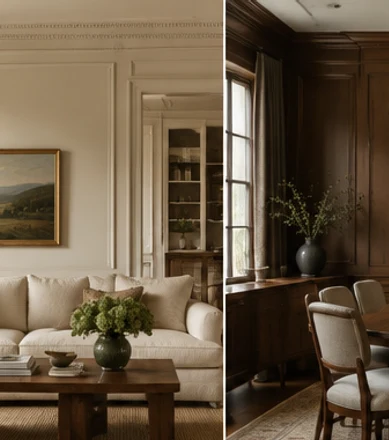
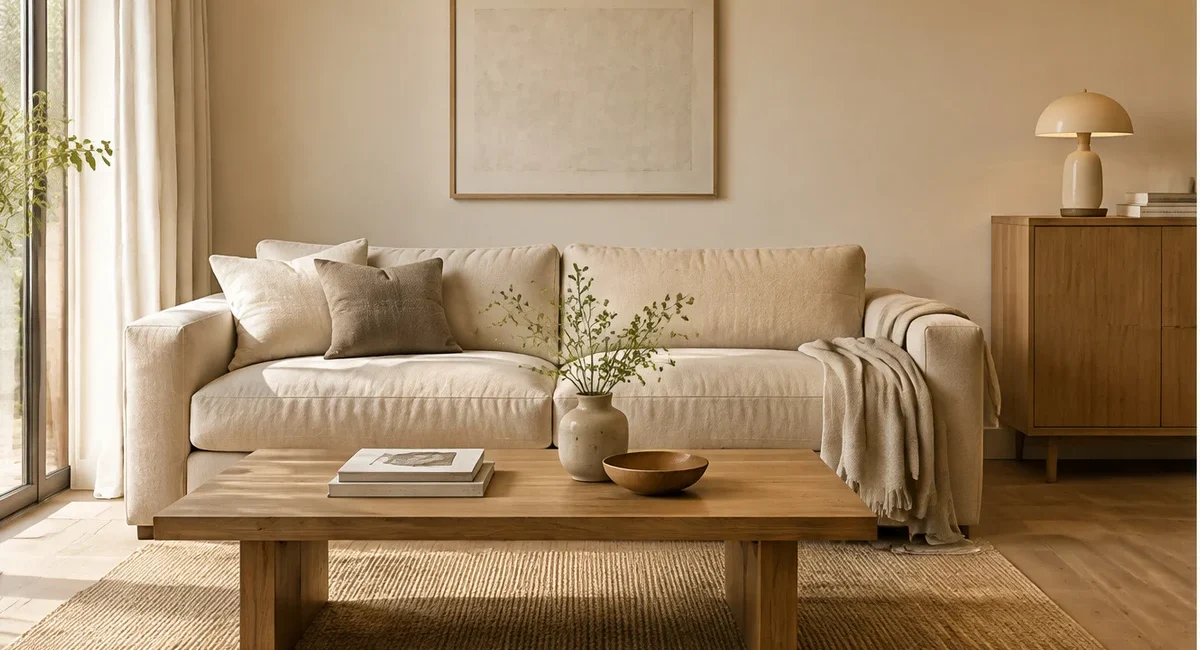
Warm minimalism works best as an editing approach, not a rule about how few objects a home should contain. In this guide, it means keeping the things that support daily life, giving them enough space to work, and choosing materials and details that make the result feel comfortable rather than empty.
A room can contain very little and still feel inconvenient. It may have no place for a drink, nowhere for books, or seating chosen for its silhouette rather than comfort. Removing objects only helps when the remaining arrangement is more useful and more enjoyable.
These warm minimalist decor ideas focus on six decisions you can apply gradually: the large furniture plan, material contrast, closed storage, the bedroom routine, dining, and personal details. You do not need to replace everything with a new neutral collection. Start by understanding what the home needs and what you genuinely want to keep.
Six ways to create a warmer minimal home
1. Keep the Furniture That Does a Clear Job

Look at each large piece and identify its role. The sofa provides comfortable seating; a table gives a reachable surface; a cabinet stores the things used in the room. Pieces that duplicate a function without improving it deserve a closer look.
Do not remove something simply because it looks traditional or visually substantial. A well-made inherited cabinet may contribute more to the home than several new slim units. Minimal editing is about the whole arrangement, not a demand that every object have a delicate outline.
Protect the routes between the useful pieces. A room often feels calmer when you can move through it without negotiating decorative furniture. Mark the footprint of a proposed replacement and test the route with drawers or doors open.
Allow some surfaces and walls to remain quiet. Empty space is not automatically unfinished space. It can separate the important pieces and make a favorite material or artwork easier to appreciate.
To test the arrangement, temporarily remove one nonessential item and live with the change. If you miss its function, return it or solve that function better. If you only miss seeing something in the gap, give yourself time before filling it again.
2. Choose a Small Material Palette With Real Differences

A limited palette becomes more interesting when its materials differ in texture and depth. Smooth painted walls, woven upholstery, visible wood grain, and a matte ceramic object can create a layered room without many separate colors.
Give each material a purposeful role. A wood table, fabric chair, and practical rug contribute through the room’s main functions. This is often more convincing than keeping the large furniture uniform and trying to add warmth with many tiny accessories.
Consider the scale of texture. A pronounced weave or strong grain can become a visual feature, so keep some neighboring surfaces quieter. The room does not need every material to have the maximum possible texture.
Choose finishes around maintenance as well as appearance. Read care instructions and think about daily use, pets, children, and cleaning. A home will not feel relaxed if the chosen surfaces make ordinary activities seem risky.
Start with three samples: the main upholstery, a wood finish, and a supporting textile. Compare them in the room. If they provide enough variety together, resist adding several more materials simply because each one is attractive separately.
3. Make Storage Convenient Enough to Preserve the Simplicity

A minimalist-looking room still needs somewhere for its practical belongings. If the only way to clear the coffee table is to carry everything to another room, the arrangement may not last. Put storage close to the activities that generate the objects.
Group belongings by use before buying containers. Books, work supplies, remotes, and games need different spaces. One well-planned drawer or cupboard can be more effective than a collection of matching baskets with no defined contents.
Keep the most-used items easy to reach. Reserve less convenient storage for suitable occasional belongings. Measure openings and mechanisms as well as capacity, because a drawer blocked by furniture does not contribute much to an efficient routine.
Do not treat closed doors as a reason to keep everything indefinitely. Review the contents periodically and remove what no longer belongs. The goal is not to transfer all visible clutter into an inaccessible cupboard.
At the end of a normal day, put the room back in order after a normal day. If the process requires several trips or complicated sorting, simplify the destinations. A warm minimalist home should be easy to reset, not dependent on constant discipline.
4. Let the Bedroom Arrangement Follow the Sleeping Routine

Start with the bedding you actually use and a bedside arrangement that supports the evening routine. A comfortable cover, the right sleeping pillows, a reachable lamp, and somewhere for a book may be enough to make the room feel complete.
Add visual softness through one or two textures rather than a large quantity of decorative cushions. A woven coverlet or a lightly folded throw can provide interest without requiring a separate storage routine every night.
Keep surfaces practical. The bedside table should have a clear landing area, and the dresser should not be so carefully arranged that everyday use becomes inconvenient. A drawer can handle small necessities while one personal object remains visible.
Choose art and lighting for the actual room. One well-proportioned piece can have more presence than several small items spread across every wall. Check the lamp from the bed so a clean-looking design does not leave a bare bulb in your eyeline.
For a more detailed approach, our neutral bedroom guide explains how tonal contrast and texture can make a restrained scheme feel layered rather than flat.
5. Keep the Dining Area Ready for a Meal
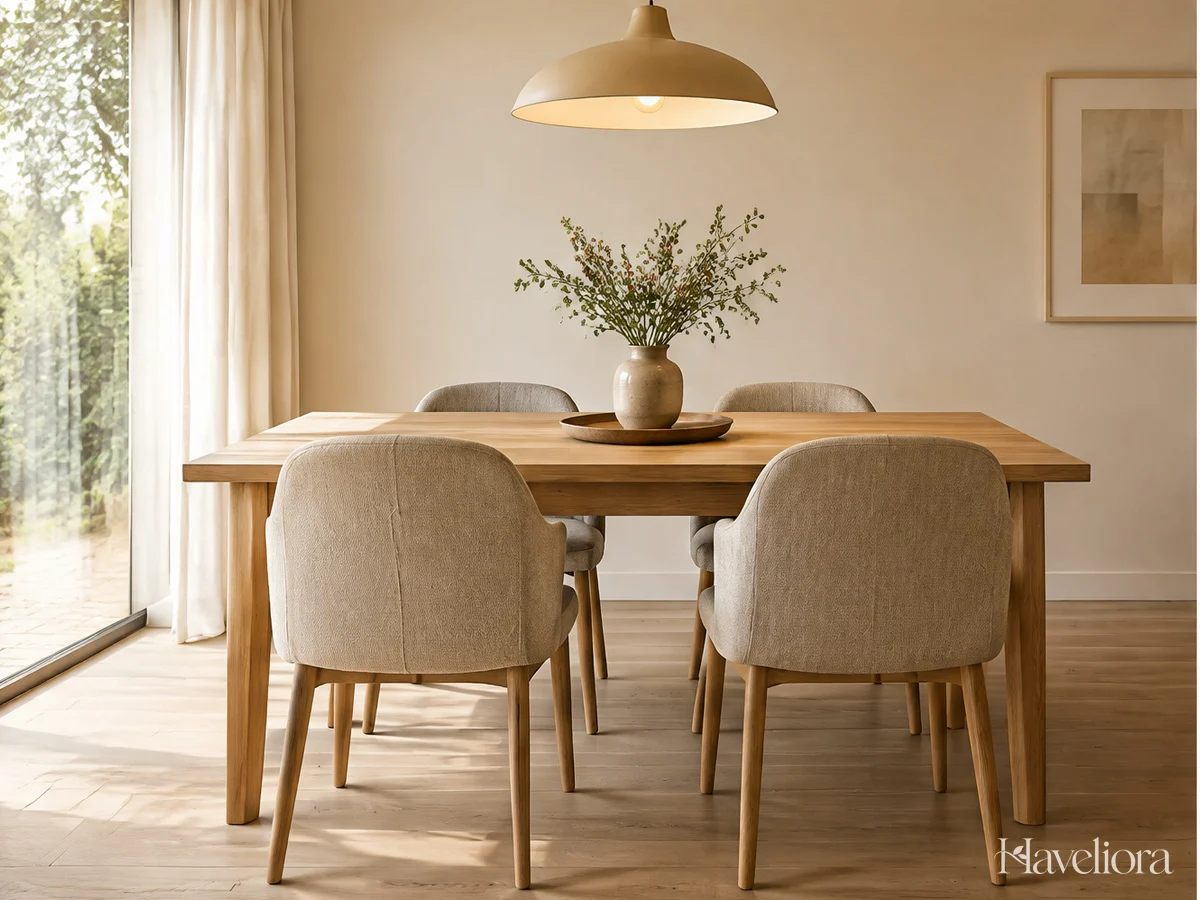
A clear table is not necessarily an undecorated table. Its shape, material, chairs, and light already contribute to the room. A low bowl or one removable textile may be all the additional detail it needs.
Choose seating by comfort and movement. Slim-looking chairs can support a lighter composition, but their relationship to the table matters more than their outline. Check knee space, arm clearance, and how far the chairs move when occupied.
If the table also supports work or hobbies, provide a nearby home for those supplies. Minimal styling becomes frustrating when the surface is repeatedly cleared into a temporary pile. The secondary function should have a simple setup and reset.
Let one element lead visually. A distinctive table can work with quieter chairs; a more expressive chair shape may suit a plain table. Avoid turning every piece into a separate statement simply because the room contains fewer objects.
Before you finish, set the table for an ordinary meal and check whether the decoration leaves enough usable area. Remove anything that consistently competes with food, conversation, or the activity the surface needs to support.
6. Keep the Details That Make the Home Yours

Minimal editing should not remove the evidence that someone lives in the home. A favorite book, a handmade bowl, a family object, or an artwork you genuinely enjoy can provide the character that a coordinated accessory set cannot.
Choose a small number of display locations rather than spreading meaningful objects thinly across every surface. One well-placed piece can be more noticeable than the same object surrounded by many unrelated decorations.
Let useful personal objects remain part of the routine. A bowl can hold keys, a treasured box can organize small belongings, and the book you are reading can stay beside the chair. Their function helps them feel integrated rather than staged.
Do not force every meaningful piece to match the palette exactly. A small contrast can make a quiet room feel more individual. Connect it through placement or one related color elsewhere if needed, but avoid disguising its character to preserve perfect uniformity.
Ask yourself one final question: which objects would you keep if the decorating style changed? Give those pieces a considered place. The aim is a clearer home, not a home stripped of memory.
A Gradual Editing Method
Work on one room at a time. Remove obvious duplicates and objects with no useful or personal role, then pause. Do not immediately replace the cleared space with new minimalist accessories.
Next, improve the practical system that causes recurring clutter. A more convenient drawer or a clearer landing place may keep the room settled more effectively than stricter rules about tidiness.
Only then adjust the material palette. Change one textile or one furniture relationship and observe the result. Warmth often comes from proportion, texture, and light already available in the home rather than from a completely new collection.
For a more expressive version of clean-lined interiors, explore warm modern living rooms. To coordinate several rooms without making them identical, see neutral home decor ideas.
Frequently Asked Questions
Does warm minimalism require beige?
No. A restrained arrangement can include deep colors or brighter accents. Keep the relationships deliberate and allow some surfaces to remain quiet. The guiding principle is thoughtful editing, not a compulsory color family.
Can I keep collections?
Yes. Give a selected group a clear display area and store or rotate the rest when appropriate. A collection can have strong presence without occupying every surface in the home.
How do I avoid making the room look empty?
Make sure the useful functions are supported, then vary texture, shape, and depth. Add a personal detail where it can be appreciated. Do not confuse a missing practical surface or uncomfortable lighting with a need for more ornaments.
A warm minimalist home is not measured by an object count. It is measured by how well the chosen pieces support daily life and how naturally the personal details belong among them.
Other Articles
Neutral Home Decor Ideas That Connect Rooms Without Making Them Identical
Small Dining Area Ideas for Comfortable Everyday Meals