
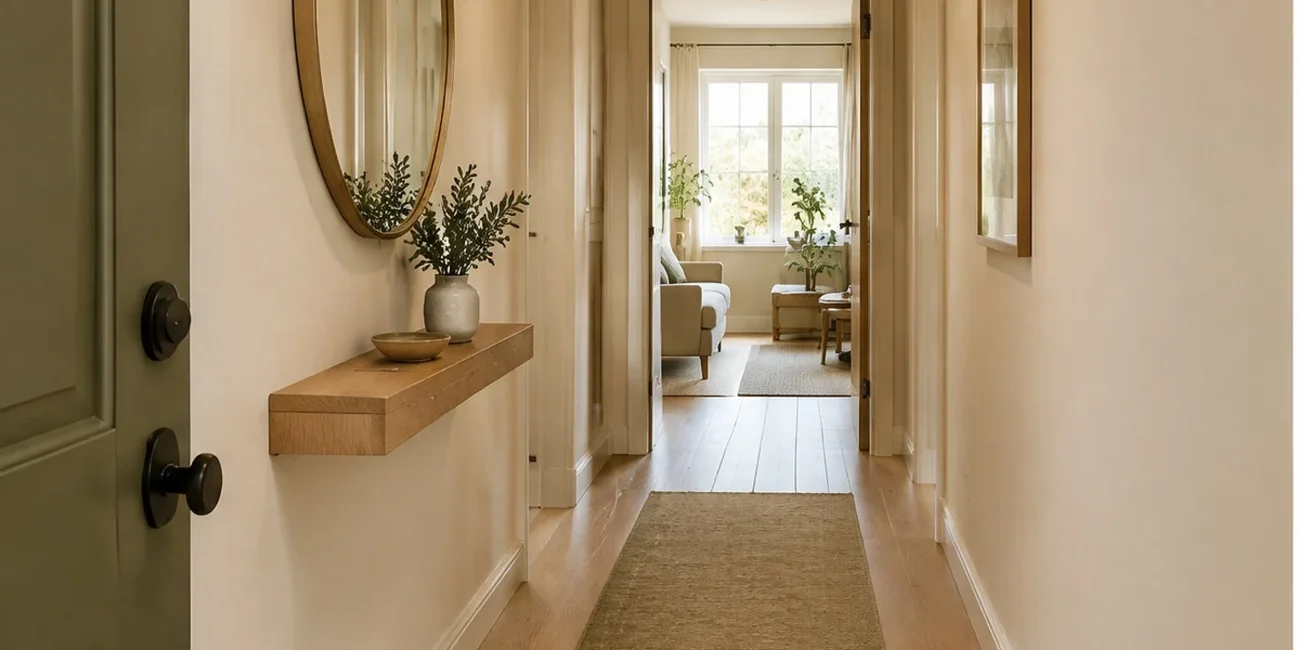
An entryway is a small space with a demanding job. It catches shoes, coats, bags, keys, and the objects carried in from outside, often before there is time to decide where anything belongs. When those arrivals have no clear destination, the entrance becomes a temporary storage area that never quite resets.
The best small entryway ideas begin with that sequence. Think about what you put down first, where you sit to change shoes, and which items need to leave with you the next morning. Then give the essential steps a place without narrowing the route into the home.
You do not need a separate hall or a large console table. A shallow shelf, suitable hooks, and a small amount of closed storage may be enough. This guide covers six decisions that help a compact arrival area feel welcoming because it works, not because it contains a collection of hallway accessories.
Plan the arrival sequence
1. Start With the Door Swing and the First Few Steps

Open the door fully and mark the space it needs. Then walk into the home carrying the kind of bags you normally bring. The route may need more usable room than it appears to when you stand looking at an empty hallway.
Choose furniture by depth as well as width. A long shallow shelf may preserve circulation better than a small but deep table. Watch for projecting handles, sharp corners, and objects placed at the point where people turn into another room.
Keep the entry route and any required exit clear. These ideas concern space inside your home; do not extend storage into a shared corridor or communal escape route. Follow the rules that apply to your building and tenancy.
A mirror or piece of art can provide a welcoming focal point without taking up floor area. Place it where it does not compete with the door’s movement, and use appropriate fixings for the wall and object. A visually relaxed arrangement should still be stable.
Keep this priority in mind: the entrance needs to work in its busiest moment, not only when all the coats are elsewhere. Test the route with the household’s normal belongings in place before selecting a decorative console.
2. Store the Shoes You Use Here, Not the Entire Collection

Decide how many pairs genuinely need to remain by the door. Everyday shoes can stay close, while occasional footwear may belong in bedroom or wardrobe storage. Trying to fit the whole collection into a narrow hall can overwhelm the area before any other function is considered.
Check the cabinet’s internal dimensions. Boots, larger shoes, and different sole shapes may not fit the same compartments. A slim tilt-out cabinet can be useful, but its capacity should be judged with the actual footwear rather than the product photograph.
Plan for wet or dirty shoes separately. Follow the furniture’s care guidance and avoid putting damp items into a closed compartment that is not suited to them. A suitable temporary drying position may be needed without turning the walking route into a shoe display.
Secure storage furniture as instructed, particularly narrow units with moving doors or drawers. Their compact footprint does not make them immune to instability. Do not use the top as a seat unless the product is designed and rated for that purpose.
To keep shoe storage manageable, assign each person a small daily allowance of entryway shoe space. When it is full, return an occasional pair to its main storage rather than adding another rack.
3. Give Hooks and Rails a Capacity You Can Maintain
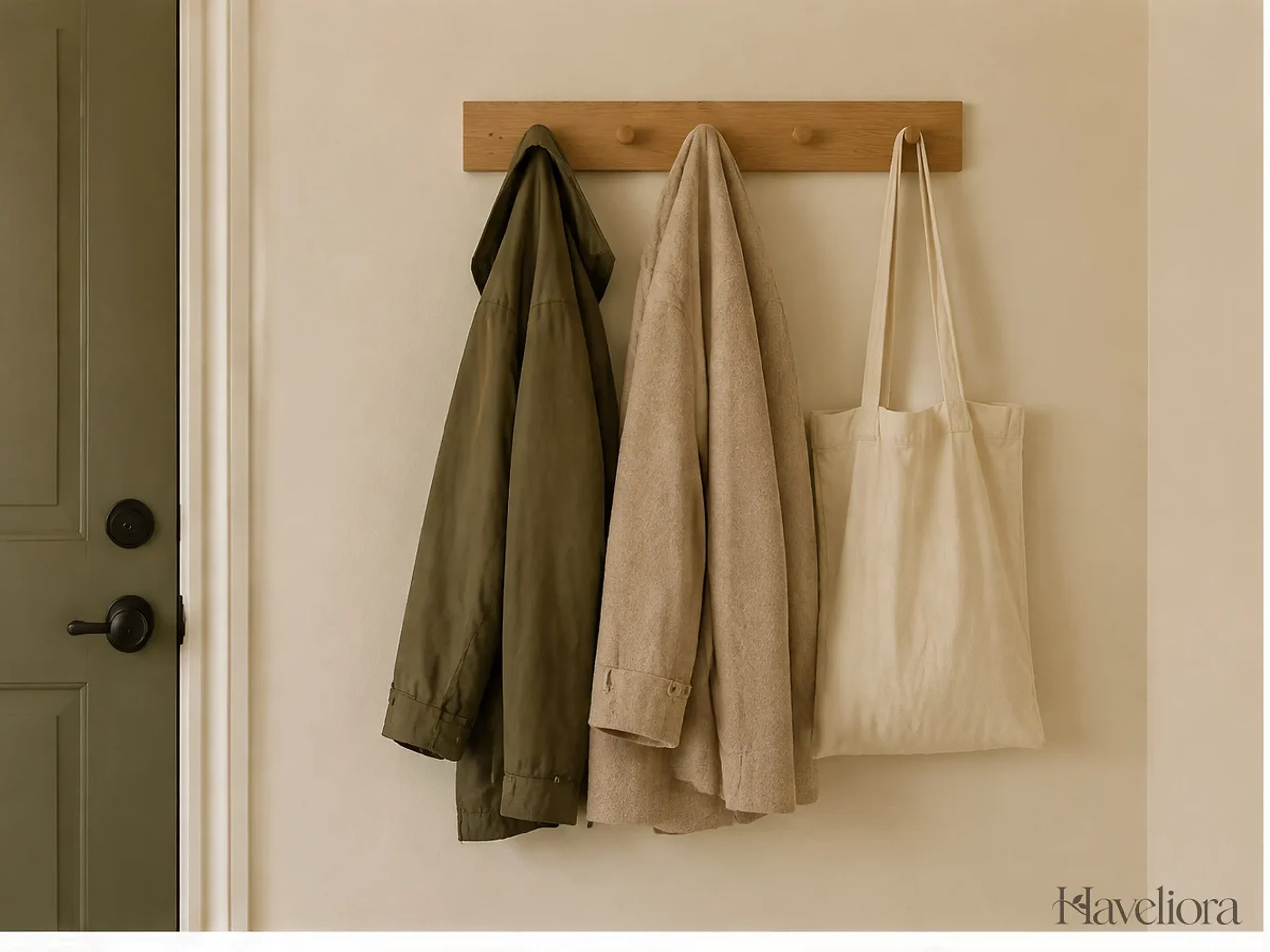
A hook rail can look tidy when empty and become a bulky obstacle once coats hang from it. Measure the depth of the belongings, not only the hardware. A row placed on a narrow turning point may reduce the useful route substantially.
Keep the selection current. The coat worn this week belongs near the door; several out-of-season layers may be better elsewhere. The same applies to bags. Give the daily bag a convenient place and store occasional ones in a more suitable area.
Choose fixing and load capacity for the real use. Wet outerwear and a full bag can weigh more than an empty display coat. Follow the product instructions and use hardware appropriate for the wall. Do not add hooks wherever drilling happens to be easiest.
Set the height around the people using the area. A child-friendly position can make returning a coat easier, while adults may need a separate rail. Check that low-hanging items do not trail across shoes or the floor.
Once a week, review the hooks once a week. Return the pieces no longer in active use and leave one place available for an arriving guest or an extra bag. A little spare capacity is more useful than a perfectly full arrangement.
4. Add a Seat Only When It Improves the Routine

A seat can make changing shoes easier, but its position needs to support the movement. Check that you can sit, bend, and stand without hitting the door or blocking another person. A bench that only fits when nobody occupies it is not a successful use of the space.
Choose the seat height and support around the household. A low decorative stool may not be comfortable for everyone. Test a similar height before buying, and use furniture designed to carry a person rather than treating a storage box as an improvised bench.
Storage beneath the seat can be useful when it remains accessible. Open shoe shelves may suit everyday pairs; a lift-up seat may suit occasional items, but it will be inconvenient if bags and cushions must be removed repeatedly to reach them.
Keep textiles simple and suitable for the wear. An entry seat may encounter outdoor clothing and damp belongings. Read care instructions and consider whether a plain wipeable or removable surface would be easier to maintain than a delicate decorative cushion.
No room for a bench? Leave the route clear and use a suitable seat elsewhere in the home. An entryway does not need every conventional hallway feature to work well.
5. Create One Small Landing Place for the Things You Must Find Again

Keys, access cards, and the item you need to take out tomorrow benefit from a predictable location. Choose a small bowl, drawer, or tray that fits the routine. The container does not need to be large enough for every object carried through the door.
Separate incoming paperwork from permanent storage. A small temporary holder can catch mail until it is dealt with, but it should not become a deep archive on the entrance table. Move documents that matter to their proper storage and remove what is no longer needed.
Place important items sensibly with regard to household security and privacy. Avoid displaying sensitive papers or valuables where they are easily visible from outside. A closed drawer may be more appropriate than an open bowl for some belongings.
Leave part of the surface empty. You may need to set down a bag briefly, receive a parcel, or place something ready to leave. A shelf filled edge to edge with decorative objects has lost the flexibility that makes it useful.
At the end of the day, remove the objects that do not belong in the arrival area each evening. A small landing place stays effective only when it is a destination for selected essentials rather than a substitute for all other storage.
6. Finish With a Suitable Mat, Useful Light, and One Visual Detail

Choose a mat for the floor, door clearance, and amount of use. Check the product’s backing and care guidance, keep the edges flat, and ensure the door can move over or around it as intended. A beautiful thick rug may be unsuitable for a tight entrance.
Lighting should make the arrival area easy to navigate and the storage easy to use. A suitable wall or ceiling light may preserve floor space better than a lamp on a narrow table. Get qualified electrical help for alterations and keep portable-light cables out of the route.
Add one decorative detail that relates to the rest of the home. A small artwork, a mirror, or a repeated wood finish can establish continuity without requiring a separate entryway theme. The entrance is part of the home rather than a miniature room that needs its own complete accessory collection.
Keep fragile or unstable objects away from the point where bags swing and coats are removed. A narrow ledge may be better with a secured picture than a tall vase. Judge the arrangement during a real arrival, not only when the hall is empty.
For a final check, stand outside, enter with your usual belongings, and complete the whole sequence. The best decorative choices will remain out of the way while making the area feel intentional.
A One-Week Entryway Experiment
For the first few days, observe what accumulates and when. Do not buy storage immediately. The pile may reveal that a coat hook is too high, the shoe compartment is too small, or there is no place for one specific daily bag.
Then test a simple destination for each recurring category. Use existing containers or temporary positions to establish the routine. Once the arrangement works, choose the permanent piece by the dimensions and capacity you now understand.
Keep the system deliberately small. An entrance that needs a complex sorting process after every trip outside is unlikely to stay tidy. The easier it is to put something in its place, the more welcoming the area will remain.
For a broader compact-home plan, see small apartment decorating. For a quieter overall visual direction, explore warm minimalist decor.
Frequently Asked Questions
What if my front door opens directly into the living room?
Create a small arrival function rather than trying to build a full hallway. A suitable hook area, a shallow landing place, and limited shoe storage may be enough. Keep the main seating route clear.
Do I need a console table?
No. A shallow shelf or a small closed cabinet may provide the needed function with less depth. Choose around the objects you need to place there rather than the conventional furniture list for an entryway.
How do I stop the entrance becoming cluttered again?
Limit the area to active everyday belongings and give other items storage elsewhere. Review what is left on the surface regularly. An overloaded entrance usually needs clearer limits, not simply a larger basket.
A welcoming small entryway makes the first and last moments of leaving home straightforward. Give each essential step a place, protect the route, and keep the decoration light enough to coexist with everyday arrivals.
Other Articles

Small Dining Area Ideas for Comfortable Everyday Meals
Small Apartment Decor Ideas for Rooms That Do More Than One Job


