

The kitchens people remember from films and beautifully lived-in homes rarely feel impressive because every surface is expensive. They feel inviting because the room looks capable of supporting real life. There is enough space to cook, a table or island where someone can sit, cookware within reach, dishes that look used rather than staged, and a mixture of old and new details that makes the kitchen feel established.
This kind of kitchen has become a recurring source of inspiration because it sits between two extremes. It is not clinically minimal, but it is not cluttered. It is not rustic for the sake of being rustic, but it uses wood, textiles, pottery, and warm metals in ways that soften the functional surfaces. It feels collected rather than coordinated.
Designers often describe the well-known Nancy Meyers kitchen mood as comfortable and casual while still sophisticated, with creamy neutrals, warm wood, natural stone, classic hardware, and a strong sense that the room is used. Homes & Gardens’ guide to the look emphasizes those broad qualities. The ideas below do not recreate any specific movie set; they translate the underlying design principles into an original, practical kitchen you can adapt to your own home.
If natural wood is your main priority, start with our warm wood kitchen ideas. If you need to protect counter space, our kitchen decor guide focuses on useful styling rather than decorative clutter.
1. Use Creamy Cabinetry and Warm Wood as a Calm Foundation
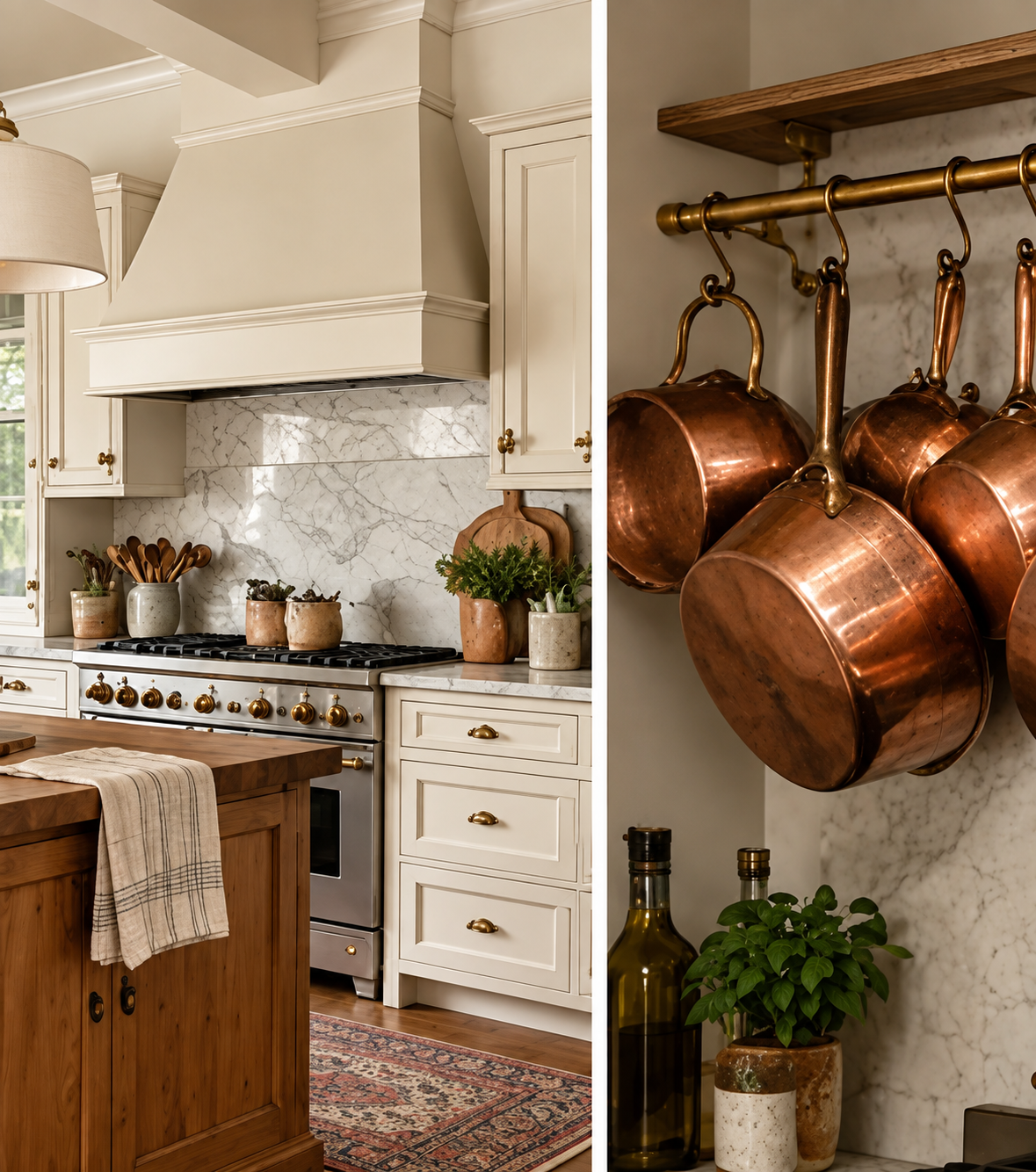
Cream, soft white, and warm off-white are useful in a collected kitchen because they create a quiet background for wood, cookware, art, books, and everyday objects. Bright white can work, but a slightly warmer neutral often relates more naturally to aged brass, copper, oak, walnut, and natural stone.
The island is a good place to introduce wood because it creates a clear center without requiring the entire kitchen to use the same finish. A wood island can look like a substantial piece of furniture, especially when the perimeter cabinets are painted. It also helps separate the working zone from the visual background.
Do not choose the paint and wood independently. Place samples together beside the floor and countertop. Some creams make oak look orange; some gray whites make walnut feel unexpectedly red. The relationship matters more than the name of either finish.
If the kitchen is small, keep the wood tone medium or light and allow the painted cabinets to reflect daylight. If the room is large, a darker walnut or stained oak island can provide needed visual weight. The island should feel proportionate to the room, not oversized simply because large islands appear frequently in inspirational kitchens.
The countertop should remain practical. Natural stone can be beautiful, but consider staining, etching, sealing, and maintenance before selecting it. Engineered materials can offer a different balance of performance and appearance. The “collected” feeling comes from the whole room, not from choosing one prestige material.
Finish the base with simple hardware. Unlacquered brass, polished nickel, aged bronze, blackened metal, and classic chrome can all work. Choose a finish that relates to the faucets, lighting, or other details without forcing every metal to match exactly.
2. Let Useful Cookware Add Warmth Instead of Hiding Everything

A kitchen feels lived-in when some evidence of cooking remains visible. That does not mean leaving every appliance on the counter. It means allowing a few useful pieces to become part of the room: a copper pan, wood spoon, enamel pot, mortar, cutting board, or cast-iron skillet that is actually used.
Store these items close to the task. A rail near the range can hold a few frequently used utensils or pans, provided the location is safe and does not interfere with heat, ventilation, or cleaning. A crock can keep wooden spoons on the counter if you use them daily. A board can remain upright against the backsplash when it is part of normal prep.
Do not create a display of cooking equipment you never touch. Dusty copper pans and decorative cutting boards make the room harder to maintain without adding real function. The collected look is more convincing when the items show a relationship to the household’s habits.
Copper and brass bring warmth, stainless steel brings clarity, and cast iron adds dark contrast. Mixing these materials can feel natural because real cooking tools rarely come in one finish. Keep the surrounding cabinet and backsplash palette relatively controlled so the varied cookware does not become visual noise.
If open storage is not practical, allow the warmth to come from handles, pot racks, a utensil crock, or a small number of pieces on the counter. Closed cabinets can still contain most of the equipment. A cozy kitchen does not need to expose everything.
Cleanability matters. Anything stored near the range may collect grease or steam. If you are not willing to wash it regularly, move it farther from the cooking zone or keep it behind a door.
3. Use Glass-Front Cabinets Selectively
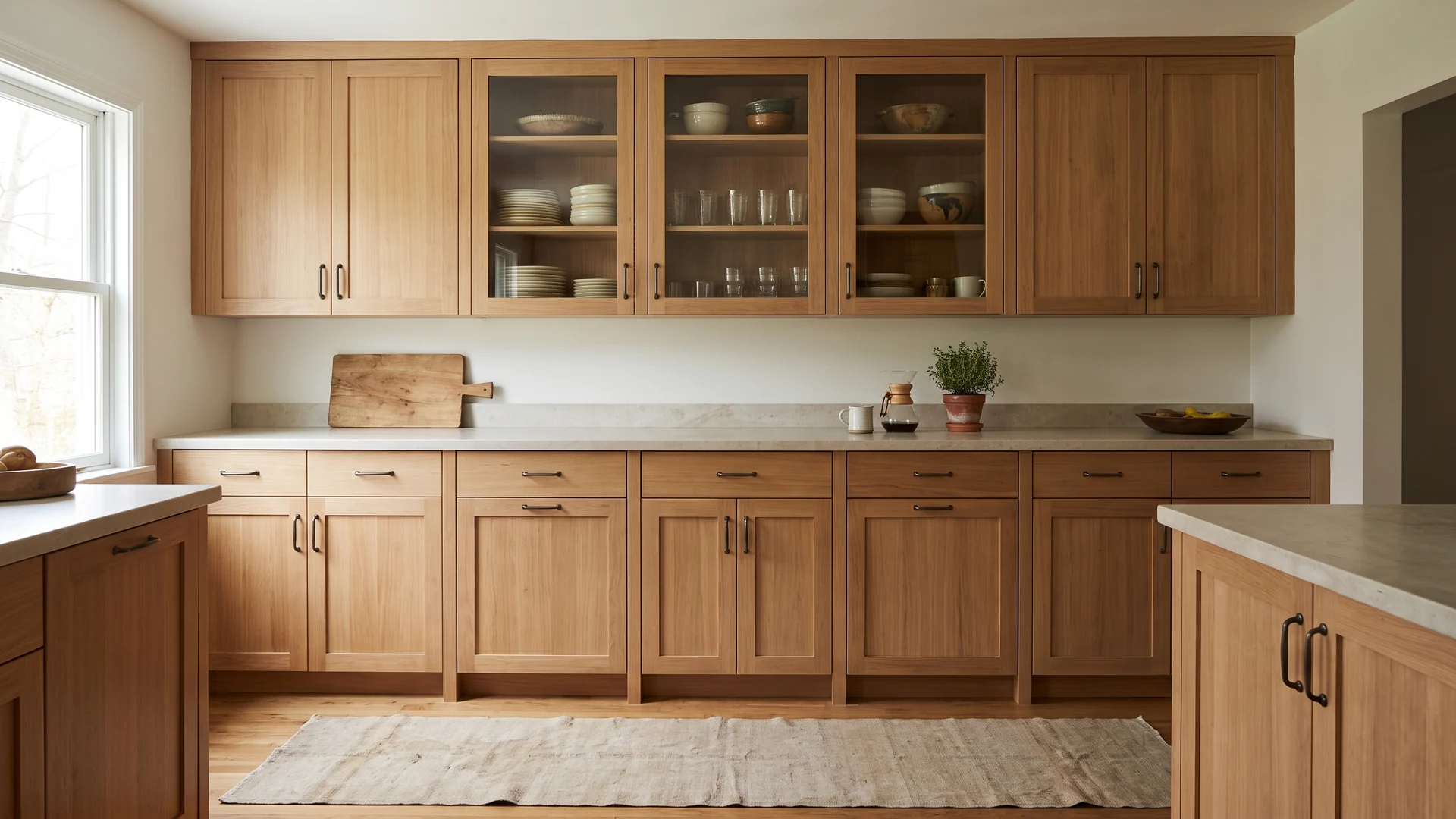
Glass-front cabinets can make a kitchen feel lighter and more personal because the contents become part of the design. They work best when used selectively. One cabinet bank for glasses, everyday plates, serving bowls, or a tea collection can provide enough variation without requiring every cupboard to be perfectly organized.
Keep the contents simple. Repeating white or cream dishes can create calm, while a few colored ceramics add character. You do not need to arrange everything by size with museum precision, but avoid stuffing the cabinet so tightly that the glass becomes a window onto clutter.
Interior lighting can make glass cabinets attractive in the evening, but it is optional. If you add it, use a soft, even source rather than a bright spotlight that exposes every detail. Wiring and heat should be planned appropriately.
Reeded or textured glass can provide a middle ground. It allows light and shape to show while softening the visual detail of the contents. This is useful if you want the architectural effect without fully displaying every item.
Glass-front cabinets are also a good place to show the objects that carry personal history: inherited plates, travel ceramics, or a favorite serving piece. Keep them accessible enough that they can still be used. A collected kitchen is strongest when beautiful objects participate in daily life.
If your storage is already tight, do not sacrifice practical closed cabinets for glass merely to achieve a look. Function should determine the ratio.
4. Consider a Worktable or Freestanding Prep Piece Instead of an Oversized Island

Large islands are useful in the right room, but they are not the only way to create a central working surface. A freestanding table, butcher-block workbench, narrow prep table, or furniture-style island can bring a more relaxed quality and preserve circulation in kitchens that cannot comfortably support a massive fixed block.
Measure the routes around the proposed piece. The table should not interfere with appliance doors, cabinet drawers, or the main path between sink, range, and refrigerator. If several people cook together, leave enough room to pass without constant negotiation.
A freestanding piece can also introduce a different wood or paint finish without forcing it into the cabinet design. That independence makes the room feel collected. An older table with a durable top can sit beside new cabinets, or a simple contemporary worktable can add clean contrast to a traditional kitchen.
Storage underneath should remain practical. Open shelves can hold heavy pots or baskets if those items are used regularly. Drawers are useful for utensils. Avoid filling the lower level with decorative baskets that make items difficult to retrieve.
If seating is included, check knee clearance and stool height. A work surface does not automatically make a comfortable breakfast bar. Decide whether the piece is for prep, dining, or both, then size it accordingly.
Recent kitchen discussions have reconsidered the idea that every kitchen needs an oversized island. A table or smaller island can often preserve more flexibility while still giving the room a social center.
5. Use a Cafe Curtain or Soft Window Treatment for a Lived-In Layer
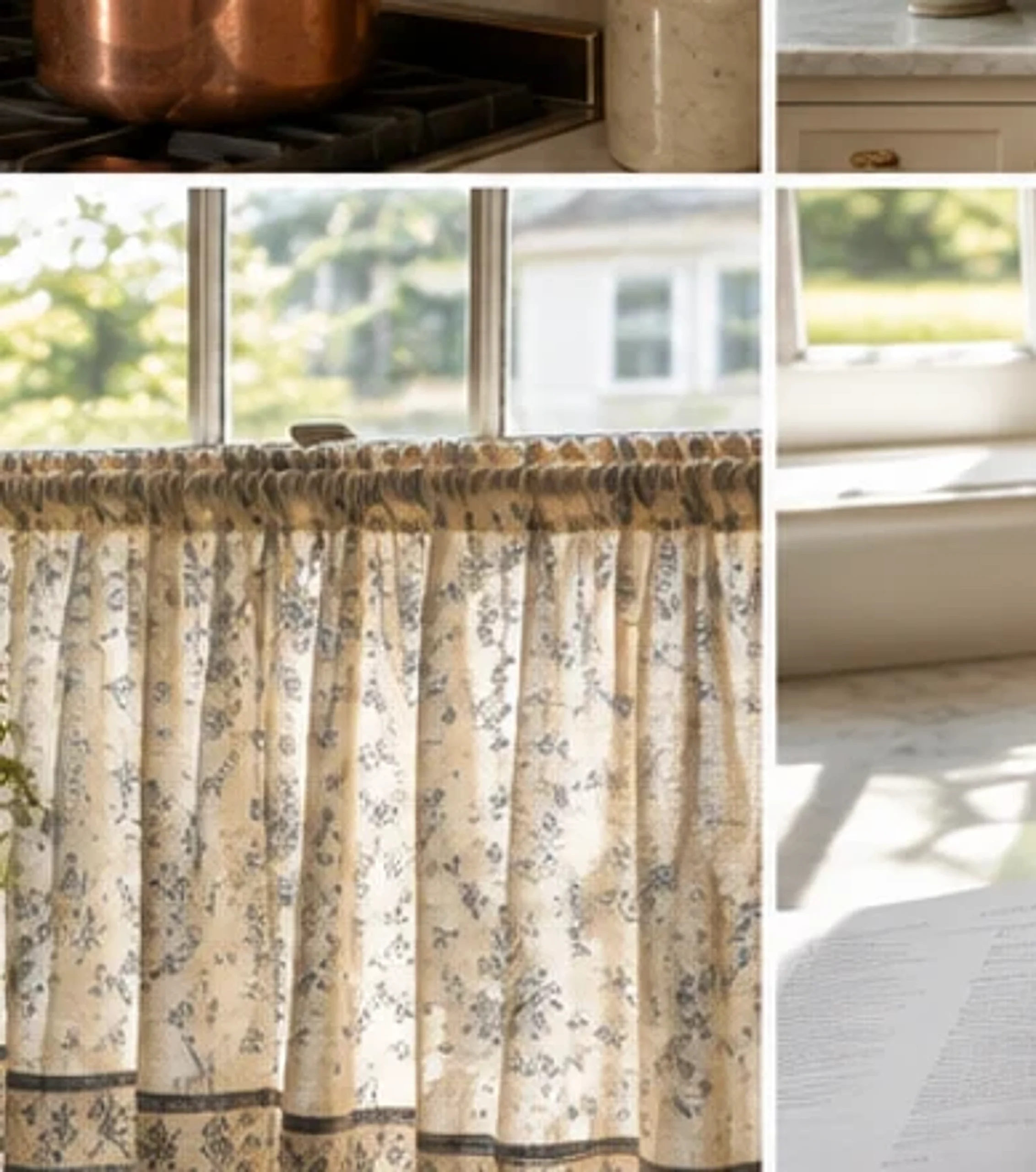
Kitchens contain many hard surfaces, so even a small amount of fabric can change the room. A cafe curtain covers the lower portion of a window while leaving the upper glass open for daylight. It can add privacy, pattern, and softness without the visual weight of full-length drapery.
Choose washable or easy-care fabric because kitchens produce moisture, grease, and food splashes. A simple stripe, check, small floral, or plain linen-like fabric can provide character without becoming a theme.
Placement depends on the window and privacy needs. The rod can sit midway up the frame or lower, but the curtain should still allow the window to operate safely. Keep fabric away from open flames, cooktops, and other heat sources.
If a cafe curtain does not suit the architecture, consider a fabric Roman shade, woven shade, or small valance used with restraint. The goal is to soften the window, not to force one nostalgic detail into every kitchen.
Repeat one color from the fabric somewhere else—perhaps in a stool cushion, artwork, or dish towel. That subtle connection helps the textile belong to the room.
For rental kitchens, a tension rod may provide a low-commitment option where appropriate, though it must be secure and not interfere with the window.
6. Let Counters Show a Small Amount of Everyday Life

A collected kitchen should not look untouched. A bowl of fruit, open cookbook during meal preparation, favorite mug, pepper mill, or jar of utensils can provide the visual evidence of everyday life. The key is to leave enough counter clear for cooking.
Divide the counter into working and non-working zones. Keep the main prep area almost empty. Place decorative or semi-permanent objects at the end of a run, in a corner, or on a shelf where they do not need to be moved every time you cook.
Group small items on a tray if they tend to spread. Oil, salt, and pepper can live together near the range when safe. Coffee equipment can form one station. A tray makes the group easier to move and clean around.
Use bowls and containers that are useful. A fruit bowl can add color while serving a purpose. A ceramic crock can hold utensils. A cake stand that is never used may be better stored until it is needed.
Books can live in the kitchen if they are protected from splashes and steam. A short shelf or dry counter corner can hold the cookbooks you use most. Rotate them rather than displaying an entire collection where food is prepared.
The room should still look like a kitchen when the counters are cleared. The architecture, materials, lighting, and furniture should carry most of the design. Everyday objects are the final layer, not the foundation.
What Makes a Kitchen Feel “Movie-Set Cozy” Without Becoming Themed?
The memorable quality is usually not one specific object. It is the combination of function and familiarity. The room has enough work surface, seating, storage, and light, but it also contains wood, textiles, books, art, cookware, and signs of use. Nothing feels too precious to touch.
Use classic materials without trying to reproduce a particular film. Cream cabinetry, warm wood, stone, aged metal, glass fronts, cafe curtains, and open shelves are broad design tools. Your kitchen becomes original through the way those elements respond to your architecture and routine.
Personal objects matter more than references. A family recipe framed on the wall, a bowl made by a local potter, a worn cutting board, or a table inherited from relatives gives the room a story no movie set can copy.
How to Make a New Kitchen Feel Less New
New kitchens can feel flat when every finish is identical and every object is purchased at once. Introduce variation slowly. Add an older stool, vintage art, a wood table, secondhand lamp, or a few ceramics with different surfaces.
Do not artificially distress new cabinetry simply to create age. Let the durable built-in elements remain well made and allow furniture, hardware, textiles, and objects to provide history.
Mixing polished and matte surfaces also helps. A shiny faucet against honed stone, aged wood beside new paint, or smooth cabinetry with woven fabric creates depth.
How to Make an Existing Kitchen Feel More Collected
You may not need renovation at all. Replace one generic light with a more characterful fixture, hang artwork in a dry location, add a cafe curtain, move cookbooks into view, or introduce a freestanding wood piece.
Swap generic hardware if the cabinet doors are in good condition. Use the same hole spacing when possible to avoid extra work. A more substantial pull or classic knob can change the room without changing the cabinets.
Bring in useful textiles: a runner in the dining side of the room, upholstered stool, washable shade, or linen towel. Avoid placing soft materials where they will interfere with food safety or cleaning.
How to Keep the Collected Look From Becoming Clutter
Maintain clear work zones. The main prep surface, sink edge, and cooking area should be easy to wipe. If an object has to be moved every time you chop vegetables, it probably belongs elsewhere.
Use closed storage for duplicates, backups, and unattractive essentials. Display only the items that are useful or personally meaningful. The contrast between open and closed storage is what keeps a collected kitchen calm.
Review the counters monthly. Appliances and packages tend to migrate into permanent positions. If something has not been used recently, return it to a cabinet or pantry.
Color Palettes That Work for a Cozy Collected Kitchen
Cream, walnut, and brass create warmth with a classic foundation. Soft green, oak, and nickel feel fresher. Warm white, dark wood, and burgundy can create a richer room. Dusty blue, medium oak, and cream offer cooler contrast without feeling cold.
Choose the palette from the fixed surfaces first. The floor, stone, and existing appliances should influence the cabinet and textile colors. Do not force a warm cream if the countertop reads strongly cool, or vice versa.
Let small objects carry more adventurous color. Ceramics, art, books, and curtains are easier to change than cabinets.
Lighting for a Cozy Kitchen
Use bright task lighting where you cut, cook, and clean. Add softer sources for the hours when work is finished. Pendants over a table or island, under-cabinet lighting, wall lights, and a small lamp in a safe dry location can create several modes.
Do not rely on decorative pendants for all task lighting. Their primary beam may not reach the counter evenly. Plan the practical layer first, then add atmosphere.
For a high-end feel, the relationship between fixture scale and architecture matters more than buying an expensive light. A tiny pendant over a large island can look accidental; an oversized fixture can obstruct views and movement.
Cozy Collected Kitchen Ideas for Small Spaces
In a small kitchen, use fewer character pieces at a useful scale. One wood shelf, one cafe curtain, one artwork, and one attractive utensil crock can provide enough personality. Avoid replacing essential closed storage with large areas of display.
A narrow freestanding cart or table can add prep space if it does not obstruct circulation. Test the footprint with tape before buying.
Keep the palette connected to adjoining rooms so the compact kitchen does not feel visually cut off. Repeating one wood tone or wall color can help.
Where to Spend and Where to Save
Spend on the working parts: reliable cabinetry, durable worktops, functional lighting, faucets, ventilation, and appliances appropriate to your needs. These affect daily use and are expensive to replace.
Save on the collected layer. Art can be secondhand, cafe curtains can be simple, vintage tables may be less expensive than custom islands, and everyday ceramics can become part of the display.
Common Mistakes
Do not copy a famous kitchen detail-for-detail. Your room has different proportions and routines. Do not fill open shelves with objects solely for appearance. Do not install an island that blocks the working routes. Do not sacrifice task lighting for mood.
Most importantly, do not confuse clutter with personality. Personal rooms still have clear surfaces, accessible storage, and enough empty space for the useful things to stand out.
Frequently Asked Questions
What defines a cozy collected kitchen?
A mixture of practical storage, warm materials, useful objects, personal details, varied lighting, and furniture or finishes that do not look as though they were purchased as one set.
Do I need cream cabinets to get the look?
No. Green, blue, wood, warm gray, and deeper colors can all work. Cream is simply one flexible backdrop for a layered room.
Can a modern kitchen feel collected?
Yes. Keep the cabinetry simple and introduce character through a wood table, art, ceramics, mixed lighting, books, textiles, and one or two older pieces.
Are open shelves necessary?
No. Closed storage may be more practical. One small shelf or glass-front cabinet can provide display space without sacrificing the storage you need.
How do I make my kitchen cozy at night?
Use layered lighting so the room can move from bright task illumination to softer pendants, wall lights, under-cabinet light, or a small lamp after cooking is finished.
How do I avoid making the counters look messy?
Keep the main prep zones clear, group small items, display only useful objects, and move rarely used appliances into storage.
A One-Weekend Collected Kitchen Refresh
Clear the counters and return only the equipment used most days. Edit one shelf or glass cabinet. Replace or move one light if the room is flat at night. Add one textile at the window or table, and bring in one personal object or artwork. Stop there for a week before deciding what else is missing.
This pause is important. A collected kitchen is not built by filling every gap. It develops when useful pieces are added for real reasons.
How to Plan a Kitchen That Encourages People to Stay
Many memorable kitchens feel welcoming because they give people a place to be without standing in the cook’s path. That may be an island stool, breakfast nook, small table, or chair near the edge of the room. The social zone should be close enough for conversation but separate enough that opening the oven or carrying a hot pan does not require asking someone to move.
If you are planning seating, trace the working routes first. Mark the path between refrigerator, sink, preparation surface, and cooktop. Then place seating outside the busiest line. A beautiful stool arrangement loses its appeal when every seated person blocks a drawer.
Built-in breakfast nooks have received renewed attention in 2026 because they combine dining, conversation, and often storage in a compact footprint. A nook does not need to be elaborate. A bench, round table, comfortable cushions, and one distinctive light can create a secondary destination that helps the kitchen feel like a room rather than only a workspace.
Round tables are particularly useful where circulation is tight because there are no corners to navigate. Pedestal bases can also make it easier to move around the table and slide along a bench. Choose the scale from the available clearances, not from the number of seats you hope to squeeze in.
How to Add Character in a Rental Kitchen
Rental kitchens are ideal candidates for a collected approach because the permanent cabinetry may be generic, but the movable layers can still create personality. Start with lighting that plugs in or recharges, a washable cafe curtain, art in dry locations, and useful wood or ceramic objects.
Replace cabinet hardware only if the lease allows it, and store the original pieces so they can be reinstalled later. Match the existing hole spacing to avoid drilling new holes. A different knob or pull can change the character of plain cabinet doors without permanent alteration.
A freestanding table, cart, stool, or narrow cabinet can introduce warm wood and storage. Make sure the item is stable and does not block appliance doors or routes. Because the piece moves with you, it can be worth choosing something you genuinely like rather than treating it as a temporary compromise.
Removable wallpaper or peel-and-stick products can be useful in some situations, but test a hidden area and follow the manufacturer’s guidance. Rental walls and cabinet finishes vary, and “removable” does not guarantee damage-free removal on every surface.
How to Use Art in a Kitchen Without Making It Impractical
Art can make a kitchen feel like part of the home rather than a purely functional zone, but placement needs common sense. Keep framed work away from direct splashes, steam, open flame, and areas that require frequent wiping. A wall near the dining side, pantry, breakfast nook, or doorway is usually safer than the backsplash behind the range.
Do not limit yourself to food-themed art. Landscapes, portraits, abstract work, family photographs, vintage prints, and small textiles can all belong in a kitchen. The room becomes more personal when the art reflects the household rather than the function of the room.
Frame styles can be mixed, especially in a collected kitchen. One wood frame, a slim metal frame, and a painted vintage frame can coexist when the colors and scale make sense. Keep enough wall space around each piece so the art does not compete with open shelves and cabinetry.
How to Make Everyday Storage Part of the Design
Collected kitchens often look relaxed because useful things are easy to reach. The key is deciding which items deserve visible storage and which should disappear behind a door. Everyday glasses, favorite mugs, cookbooks, or serving bowls may work on open shelves. Backup supplies, plastic containers, cleaning products, and rarely used appliances are usually calmer in closed storage.
Use baskets and boxes inside cabinets rather than covering open surfaces with containers. Internal organization may not be visible, but it is what allows the exterior of the kitchen to remain relaxed. A beautiful counter is easier to maintain when every unphotogenic object has a specific home.
Leave some cabinets imperfect. A collected kitchen is not a showroom, and internal storage can prioritize convenience over visual symmetry. The discipline belongs in the visible zones and the working routes.
How to Adapt the Look to a Contemporary Home
If your architecture is modern, resist the temptation to add traditional details everywhere. Keep the clean cabinetry and introduce warmth through a wood island, one classic lamp, textiles, ceramics, and art. The contrast can create the same sense of ease without making the kitchen feel like a historical imitation.
Use fewer decorative moldings and let materials do more of the work. Honed stone, grain-forward wood, warm metal, linen, and pottery can add depth to flat-front cabinetry. A simple striped cafe curtain or vintage stool may be enough nostalgia.
The goal is not to make every contemporary kitchen look traditional. It is to borrow the sense of comfort, usability, and personal history that makes collected kitchens appealing.
Let usefulness remain the final editing rule.
Final Thought
The most inviting collected kitchens feel as though they have a life beyond design. Use warm wood, creamy paint, cookware, glass-front storage, a flexible worktable, soft window treatment, and a few everyday objects to create that sense of history and ease. Keep the working surfaces clear, let function determine what stays visible, and choose details that belong to your home rather than a famous reference. The result can feel cinematic precisely because it feels believable.
Other Articles

Kitchen Upgrades That Make a Space Look More Expensive
Warm Wood Kitchen Ideas for a Timeless, Welcoming Space


