

A collected living room looks as though it has developed over time. The furniture does not all come from one range, the art is not chosen simply to match the sofa, and the shelves contain objects that have a reason to be there. Yet the room still feels edited. That balance—personal but not cluttered—is what makes collected interiors so appealing.
The idea is especially relevant in 2026 as living room design continues to move away from identical furniture sets and anonymous minimalism. Designers and editors have been highlighting mixed seating, vintage pieces, layered patterns, books, art, and rooms with a stronger sense of story. The goal is not maximalism for its own sake. It is to create a space where old and new pieces can coexist without the room feeling random.
A collected room is built through relationships: a vintage table beside a contemporary sofa, an inherited frame above a modern console, patterned textiles that share one color, or different wood tones connected by a rug. You do not need expensive antiques or a large collection. You need enough repetition to create cohesion and enough variation to create character.
If your room currently feels too matched, our modern living room ideas can help you keep clean lines while adding warmth. If it feels visually crowded, the cozy living room guide has practical editing advice. This article focuses on how to combine pieces so the result feels personal rather than accidental.
1. Pair One Older Piece With a Contemporary Anchor

The easiest way to begin a collected living room is to introduce one piece with a different age or character beside a dependable contemporary anchor. A modern sofa can sit next to a vintage side table, old chest, inherited cabinet, or secondhand stool. The contrast makes both pieces more interesting because neither is forced to carry the entire room’s personality.
Start with function. If you need a side table, look for an older piece that can actually hold a lamp and drink. If you need storage, consider a vintage cabinet or chest rather than buying a decorative object simply because it has patina. Useful pieces integrate more naturally because they participate in the room’s routine.
Do not worry about perfect condition. Small scratches, repaired joints, faded finishes, and visible grain can contribute to the collected feeling. However, structural stability matters. A wobbly table or damaged chair should be repaired before it becomes part of everyday use. Patina is not the same as poor function.
Scale is more important than era. A delicate side table beside a huge sectional may look too small, while a massive dark chest can overwhelm a compact sofa. Measure the height and footprint against the furniture it will sit beside. A good collected room still respects proportion.
If the older piece feels isolated, repeat one of its qualities elsewhere. A walnut table might connect to a frame, lamp base, or bookcase. A brass handle can relate to a picture light. You only need a small echo to make the difference feel intentional.
2. Display Art and Meaningful Objects With Breathing Room

Collected rooms often contain more art and objects than minimalist spaces, but quantity is not what creates character. Meaning and placement matter more. A photograph from a trip, inherited ceramic, painting you genuinely love, or object connected to a hobby will usually contribute more to the room than several generic accessories chosen only to fill shelves.
Give important pieces room to be seen. A small object disappears when surrounded by ten others of similar scale. Group related items and leave negative space between groups. On a console, one lamp, a framed work, and a shallow bowl may be enough. On a shelf, a run of books can sit beside one ceramic object rather than alternating book-object-book-object across every level.
Art does not need to share one frame style. Mixed frames can look natural when there is another connection, such as similar mat colors, recurring wood tones, or a consistent amount of space between pieces. A gallery wall should grow from the art you want to see, not from the need to fill a rectangle.
If you are nervous about hanging different works together, arrange them on the floor first. Start with the largest piece, then place smaller works around it. Photograph the arrangement and check whether any area feels overly dense. Transfer the composition to the wall only after the balance feels right.
Do not display every meaningful object at once. Rotation is useful. A few pieces can remain permanently while others move in and out with seasons or interests. This keeps shelves from becoming storage and allows individual objects to retain visual importance.
3. Mix Wood and Metal Finishes Through Repetition, Not Matching

A collected room rarely uses one exact wood finish or one metal throughout. Variation is part of the appeal. The key is to repeat enough of each family that the mixture looks deliberate. A walnut table may sit beside an oak cabinet when warm wood appears elsewhere and the contrast is supported by the rug or upholstery.
Begin with the largest wood pieces. Identify whether they are generally warm, cool, light, or dark. New additions do not need to match, but an extreme outlier may need a bridge. For example, a black-stained cabinet beside pale oak can work when black appears again in frames or lighting.
Metal works similarly. Brass, bronze, blackened steel, chrome, and pewter can mix, but avoid introducing a different finish in every small object. Choose one dominant metal and one secondary finish. Repeat each in at least two locations when practical.
Hardware does not have to dictate every lamp and frame. A brass cabinet pull does not require all-brass lighting. Think of finishes as part of the color palette: related enough to coexist, varied enough to keep the room from looking purchased as a package.
Natural materials help bridge differences. Linen, wool, leather, stone, and woven fiber create neutral transitions between wood and metal. A rug containing both warm and cool tones can connect furniture that would otherwise feel disconnected.
4. Style Bookcases Like a Library First and a Display Second
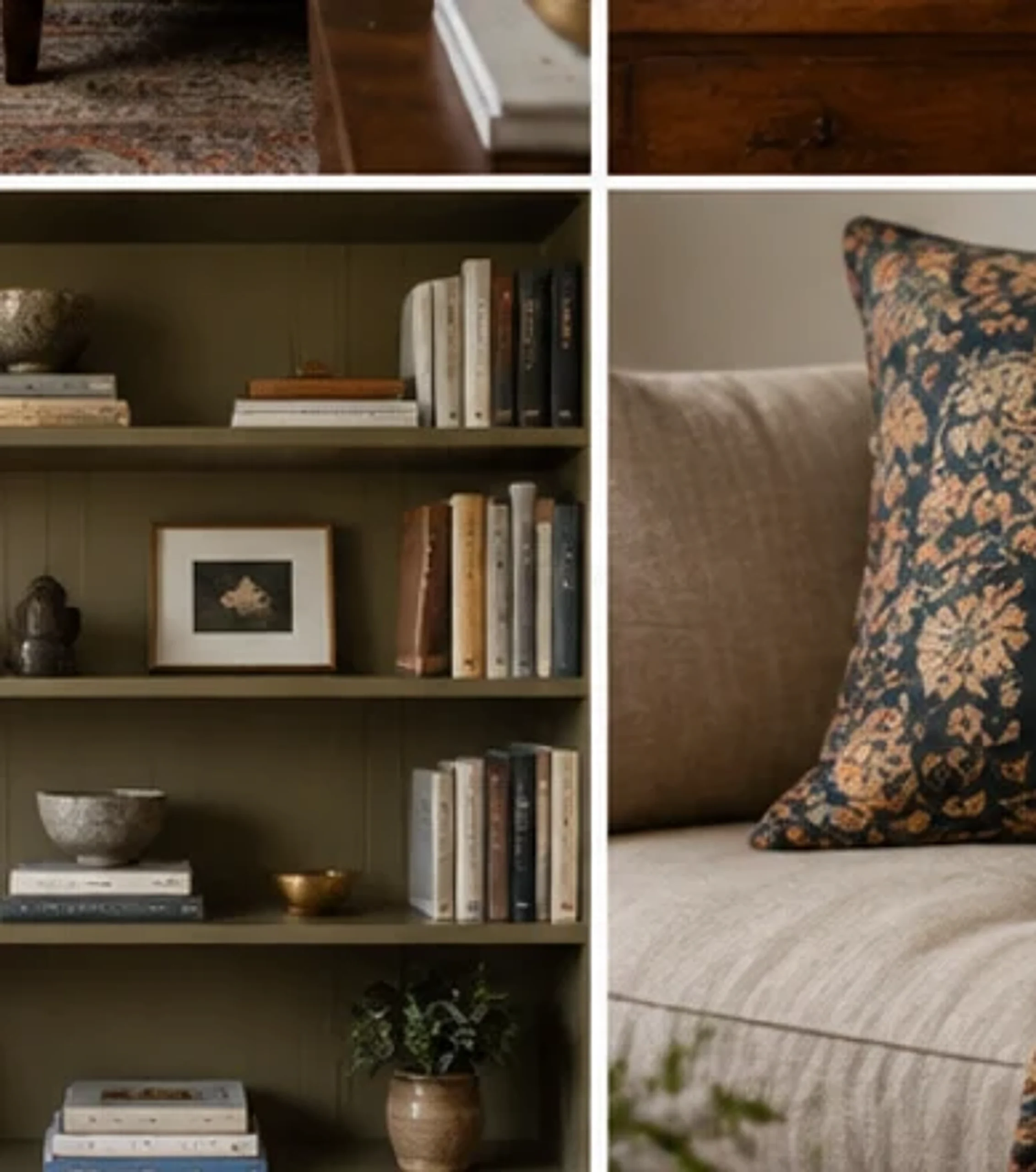
Bookcases are one of the easiest places to create a collected feeling because books already vary in color, size, age, and subject. Let them provide much of the visual interest. You do not need to interrupt every row with decorative objects.
Organize books in a way that makes sense to you. Alphabetical, by subject, by size, or loosely by room use can all work. Styling solely by spine color can be attractive, but it is less useful if you cannot find what you want. A home library should remain functional.
Leave some horizontal space on shelves rather than filling every inch. Negative space prevents the bookcase from becoming a dense wall of objects and gives the eye a place to rest. A small framed photograph, ceramic bowl, sculptural object, or lamp can occupy one area while the next shelf is mostly books.
Use objects that relate to your life. A travel souvenir, inherited piece, small artwork, or object connected to a hobby gives the shelves a reason to look different from anyone else’s. Avoid buying a collection of “shelf decor” simply to create a collected look; the effect is more convincing when the collection has been collected.
Consider a small lamp on a lower shelf or nearby surface if the bookcase disappears at night. Light can give books and objects more presence without requiring more decoration. Our living room lighting ideas guide covers shelf and accent lighting in more detail.
5. Mix Patterns at Different Scales

Pattern is one of the quickest ways to make a living room feel layered, but it can also create clutter when every textile competes. The most reliable approach is to vary scale. Pair a larger floral, geometric, or abstract motif with a smaller stripe, check, or subtle texture. Add solids to give the patterns room.
Use color as the connection. The patterns do not need to come from the same collection. If the rug contains olive, cream, and rust, a striped cushion using cream and rust can relate to it even when the motifs are completely different.
Distribute pattern rather than concentrating it all on the sofa. A patterned rug, plain sofa, one patterned chair, and a few quieter cushions may feel more balanced than six patterned cushions on an otherwise empty room. Curtains can also carry pattern, especially when the upholstery is simple.
Vintage textiles can add the irregularity that makes collected rooms feel natural. A faded rug, old woven blanket, or secondhand cushion fabric does not need to match the newer pieces perfectly. Its slight variation can soften a room that otherwise feels too polished.
Do not ignore texture as a “pattern.” Bouclé, slubby linen, ribbed velvet, woven wool, cane, and wood grain all create visual activity. If the room already contains many tactile materials, the printed patterns can be quieter.
6. Balance Old and New Across the Whole Room
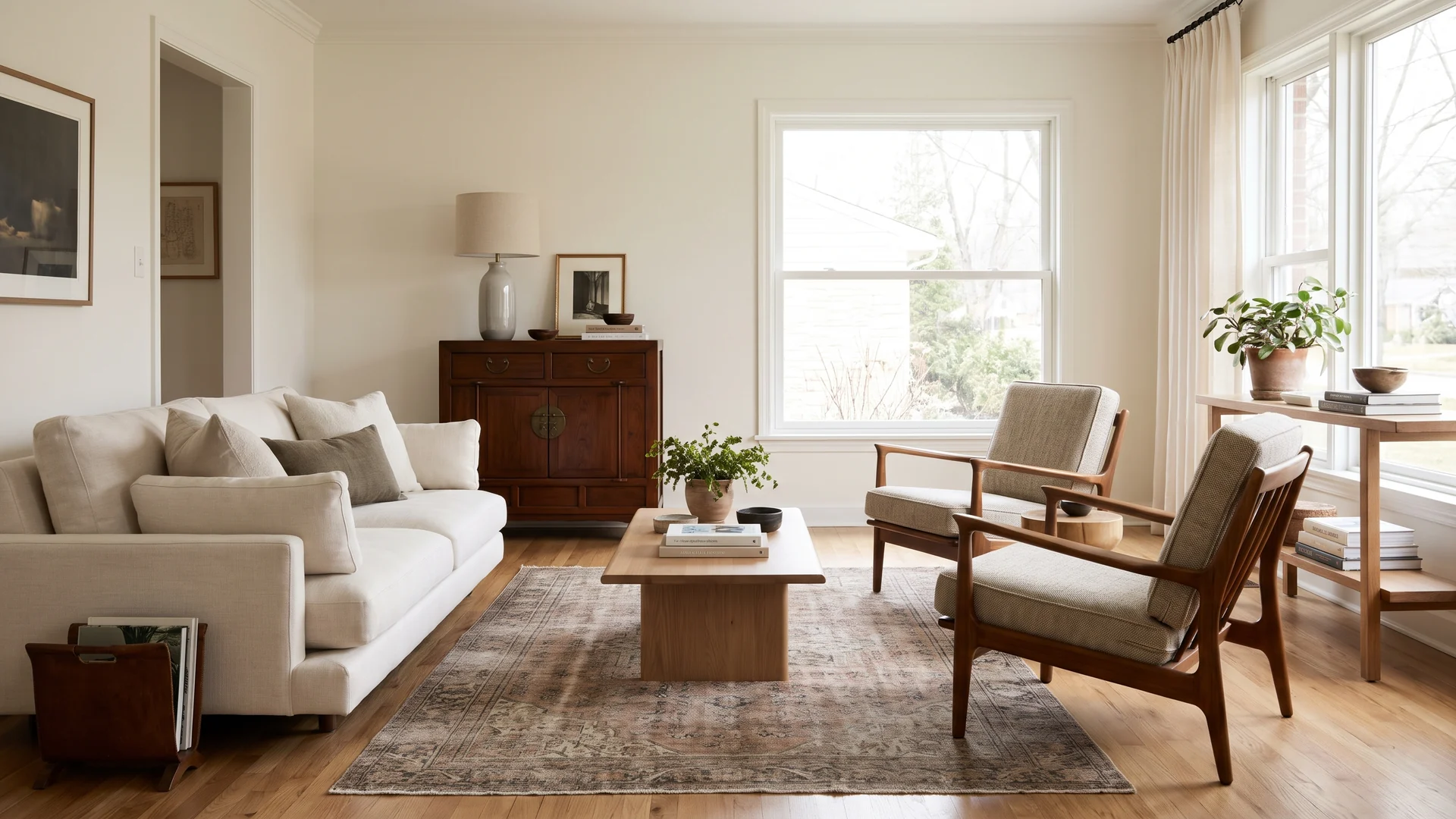
Once you have several pieces from different periods, distribute them around the room. If every vintage object sits on one wall and every new piece sits on the other, the space can feel divided. Mixing them within the same seating group creates a more natural composition.
A contemporary sofa can face vintage chairs. A new coffee table can sit on an older rug. A traditional cabinet can hold a modern lamp. A clean-lined shelf can display inherited ceramics. These relationships make the room feel as though it evolved rather than being designed in one purchase.
Keep one or two visual anchors consistent. The wall color, rug, curtain fabric, or repeated wood tone can provide continuity while furniture styles vary. This is especially useful in open-plan rooms where the collected mix could otherwise feel fragmented.
Comfort should determine which pieces remain. An attractive antique chair that no one wants to sit in may be better in a bedroom or hallway. The living room needs to support actual seating first. New upholstery can make an older frame more comfortable, but do not preserve a piece in the main room solely because it looks interesting.
Allow the room to remain unfinished. A collected interior should have space to evolve. If every wall and table is filled now, there is nowhere for the next meaningful object to go.
How to Start a Collected Living Room From Scratch
Begin with the items you already own and genuinely like. Photograph them together even if they currently live in different rooms. Look for common colors, materials, shapes, or themes. You may discover that your favorite pieces already suggest a direction.
Choose the largest functional anchor next: usually the sofa, rug, or main storage piece. It should be comfortable and durable enough to support the room. Do not force the anchor to carry all the character. A simple sofa can become much more distinctive once vintage tables, art, lamps, and textiles surround it.
Add pieces slowly. Buying an entire “eclectic” collection at once defeats the purpose and often produces a room that looks staged. Let real needs guide the additions: a side table because someone needs a drink surface, a lamp because the chair is dark, a cabinet because books need storage.
How to Edit a Collected Room That Feels Cluttered
Start with surfaces. Clear the coffee table, console, and shelves, then return only the useful or meaningful objects. Group small items so they read as one composition rather than many separate signals.
Next, check the floor. Too many small tables, baskets, stools, and plant stands can make circulation feel busy. Remove anything that is not serving a regular purpose. A collected room still needs generous paths through the furniture.
Then check the walls. If every vertical surface has art, leave one wall or section quieter. This contrast makes the displayed pieces feel more important.
Finally, photograph the room. The image can reveal repeated small objects, uneven visual weight, or a color that appears only once. Use those observations to edit rather than adding another piece to “balance” the problem.
Collected Living Room Ideas for Small Spaces
Small rooms can feel collected without containing many objects. Focus on pieces that combine character with function: an older cabinet for storage, a vintage side table, one large artwork, a patterned rug, and a useful lamp.
Use walls for books and art while keeping the floor relatively open. A tall bookcase may hold more personality than several small cabinets. One substantial side table can be calmer than multiple tiny stools.
Keep patterns concentrated. A rug and one chair can carry enough visual variety, allowing the sofa and curtains to stay quiet. The room will still feel layered without becoming visually cramped.
Where to Find Pieces Without Turning the Search Into a Project
Secondhand shops, local marketplaces, estate sales, flea markets, family storage, and vintage dealers can all be useful. Set measurements before browsing so you do not buy a beautiful piece that does not fit.
Search by function rather than only by style. “Small wood side table,” “vintage cabinet,” or “reading chair” can reveal more useful results than trying to find an item described as “collected” or “eclectic.”
Be patient. A collected room is allowed to have gaps. Using a simple temporary piece is better than buying something you do not like simply to finish the room quickly.
How to Keep the Room Cohesive
Repeat colors. A rust note in the rug can reappear in art. Black in a frame can connect to a lamp. Cream in curtains can repeat in cushions. These small echoes help unrelated pieces belong together.
Repeat shapes too. Curved chair arms can relate to a round mirror or lamp. Straight-lined shelves can connect to a rectangular coffee table. You do not need an obvious theme; quiet repetition is enough.
Maintain consistent spacing. Even varied objects look calmer when shelves and wall arrangements have breathing room. Good spacing is one of the strongest tools for keeping a collected room from becoming cluttered.
Common Collected Living Room Mistakes
The first is buying objects solely because they look vintage. Age does not automatically create meaning. Choose useful or genuinely appealing pieces.
The second is introducing too many different small finishes. If every lamp, frame, table, and object has a different metal or wood, the room may feel fragmented. Repeat a few families.
The third is filling every surface. A collected room needs empty space to make the collection visible. The absence of an object can be as important as the object itself.
Finally, avoid keeping uncomfortable furniture for the sake of character. Living rooms are for living. Comfort is not a compromise; it is part of the design.
Frequently Asked Questions
What does “collected” mean in interior design?
It describes a room that combines pieces from different times, sources, and styles in a cohesive way. The result feels developed over time rather than purchased as one matching set.
How do I mix vintage and modern furniture?
Start with scale and function, then connect the pieces through repeated colors, materials, or shapes. One vintage table beside a modern sofa is an easy starting point.
How many vintage pieces should a living room have?
There is no required number. Even one or two pieces with patina can change the room. Add more only when they serve the space and suit your taste.
How do I prevent a collected room from looking cluttered?
Leave negative space, group small objects, keep circulation clear, use closed storage where needed, and rotate displays rather than showing everything at once.
Do all the wood tones need to match?
No. Related warm or cool woods can mix successfully. Repeat tones where possible and use rugs, textiles, or metal finishes to bridge stronger contrasts.
Can a minimalist room become more collected without losing simplicity?
Yes. Add a few pieces with history, art that matters to you, books, and one patterned textile while keeping surfaces edited. Collected does not require maximalism.
A Room-by-Room Inventory Before You Buy Anything
One of the most useful ways to create a collected living room is to shop your own home before shopping anywhere else. Walk through the bedroom, dining room, hallway, storage area, and even boxes you have not opened recently. Look for pieces that have meaning or material quality but are currently underused: a small wood table, framed photograph, ceramic bowl, old mirror, lamp, stack of books, or textile.
Bring potential pieces into the living room temporarily and live with them for a day or two. A side table that felt insignificant in a bedroom may provide exactly the contrast a newer sofa needs. A painting that looked too formal in the dining room may feel relaxed above a low console. Moving objects between rooms is one of the least expensive ways to make a home feel more layered.
Take measurements before moving heavier furniture. A chest that fits in a hallway may block a living room route. A chair that looks compact from the front may have deep arms or a wide back. The collected effect should never come at the expense of circulation.
Once you have tested what you own, make a short list of genuine gaps. Perhaps you still need one reading lamp, a larger rug, or closed storage. Shopping with that list prevents the room from accumulating attractive but unnecessary objects.
How to Use Color to Unify Unrelated Pieces
Color is one of the easiest ways to create a relationship between furniture from different sources. You do not need a strict three-color palette, but a few recurring tones help the eye move around the room. Look at the rug, largest upholstery, curtains, and artwork. Identify two or three colors that already appear more than once.
Repeat those colors lightly. If the rug contains muted blue, a blue-gray book spine, cushion, or ceramic object can echo it. If a vintage chair has warm rust upholstery, that color might appear again in artwork or a throw. The repetition should be subtle enough that the room does not look deliberately color-matched.
Neutral colors can do the same job. Cream mats around different art pieces, black frames in several locations, or a repeated warm wood tone can create cohesion without adding a strong accent. This is particularly useful when the room already contains many patterned or colorful items.
Avoid correcting every mismatch. Some tension is part of a collected room. A cool blue artwork above a warm brown cabinet can be more interesting than a perfectly coordinated composition. Use repetition to establish a foundation, then allow a few exceptions.
How to Handle Sentimental Pieces That Do Not Match Your Style
Sentimental objects deserve thoughtful placement, but they do not need to dominate the room simply because they are meaningful. If an inherited piece feels visually disconnected, ask whether it can be reframed, reupholstered, refinished, or used in a different way without erasing what makes it special.
A small heirloom can be placed among books rather than isolated on a pedestal. An old photograph can receive a cleaner mat while keeping the original image. A wooden chair can gain a new cushion while retaining its frame. These changes allow the object to participate in the current home instead of becoming a museum piece.
If a piece truly does not work in the living room, it is acceptable to use it elsewhere. Meaning does not depend on the most prominent placement. A family item may be more comfortable in a bedroom, hallway, or study where its scale and style make more sense.
How to Mix Furniture Shapes Without Creating Visual Chaos
Collected rooms often contain a variety of silhouettes: a boxy sofa, rounded chair, turned-leg table, slim metal lamp, or carved cabinet. That variety can be attractive, but the room still needs a rhythm. Repeating a few shapes helps unrelated pieces feel connected.
If the sofa and coffee table are strongly rectangular, a rounded side table or curved chair can soften the composition. Repeat the curve once more in a mirror, lamp base, or bowl. If the room contains many rounded pieces, a straight-lined bookcase or console can add structure.
Pay attention to leg styles as well. You do not need every piece to have the same legs, but a room with five unrelated ornate bases can feel busy. Let one or two detailed pieces stand out and keep the rest simpler.
The goal is not symmetry. It is balance. One visually heavy cabinet on one side of the room might be balanced by a tall plant, large artwork, or substantial lamp on the other. Judge the whole composition rather than matching individual objects.
How to Make a Collected Living Room Easy to Clean and Reset
Personality is easier to enjoy when the room can be maintained. Keep enough clear surface on the coffee table for a quick wipe. Leave space between shelf groups so dusting does not require moving dozens of tiny objects. Use trays or shallow bowls to contain remotes and small everyday items.
Closed storage is especially valuable in a collected room because not everything needs to be displayed. Board games, cables, spare blankets, paperwork, and media equipment can live behind doors while books, art, and meaningful objects remain visible. This contrast keeps the room from feeling like storage.
Give temporary clutter a destination. A basket for the blanket, drawer for chargers, or hook for headphones prevents everyday life from overwhelming the styled surfaces. The goal is not to keep the room perfect; it is to make returning it to order straightforward.
A Collected Living Room Can Still Feel Current
Collected does not mean old-fashioned. Contemporary lighting, cleaner upholstery, modern art, or a simple wall color can give older pieces a fresh context. Likewise, a very modern room can gain depth from one antique or vintage object without abandoning its clean lines.
Current design trends are useful when they help you notice possibilities—mixed seating, richer color, vintage wood, reading zones—but they should not become a checklist. A collected room is strongest when it includes things you would keep even after the trend changes.
That long-term approach is also more sustainable. Repairing, reusing, and moving existing pieces often creates more character than replacing everything with new products designed to imitate age.
A Final Editing Exercise
Before calling the room finished, remove five small objects and live with the space for a day. You may put some back, but the exercise reveals which pieces were contributing character and which were simply filling gaps. Then look at the room from the doorway, the main sofa, and any adjacent space. A collected interior should make sense from more than one viewpoint.
Check that every major surface has a mix of use and breathing room. The coffee table should still accept a drink, shelves should still give access to books, and side tables should still support lamps and everyday essentials. If a display prevents the furniture from doing its job, edit the display rather than adding storage elsewhere.
Finally, notice whether one color, material, or era appears only once and feels isolated. You do not have to repeat it, but if it looks accidental, either connect it quietly to another element or remove it. This last pass is what turns variety into cohesion.
Final Thought
A collected living room should reveal something about the people who live there. Mix old and new, but keep the furniture useful. Display art and objects with enough space to matter. Let books behave like books, allow wood and metal to vary, and use pattern with restraint. Most importantly, leave room for the space to change. A home that develops gradually often feels more personal than one designed to look finished on the first day.
Other Articles

Warm Wood Kitchen Ideas for a Timeless, Welcoming Space
Living Room Lighting Ideas That Skip the Big Light


