
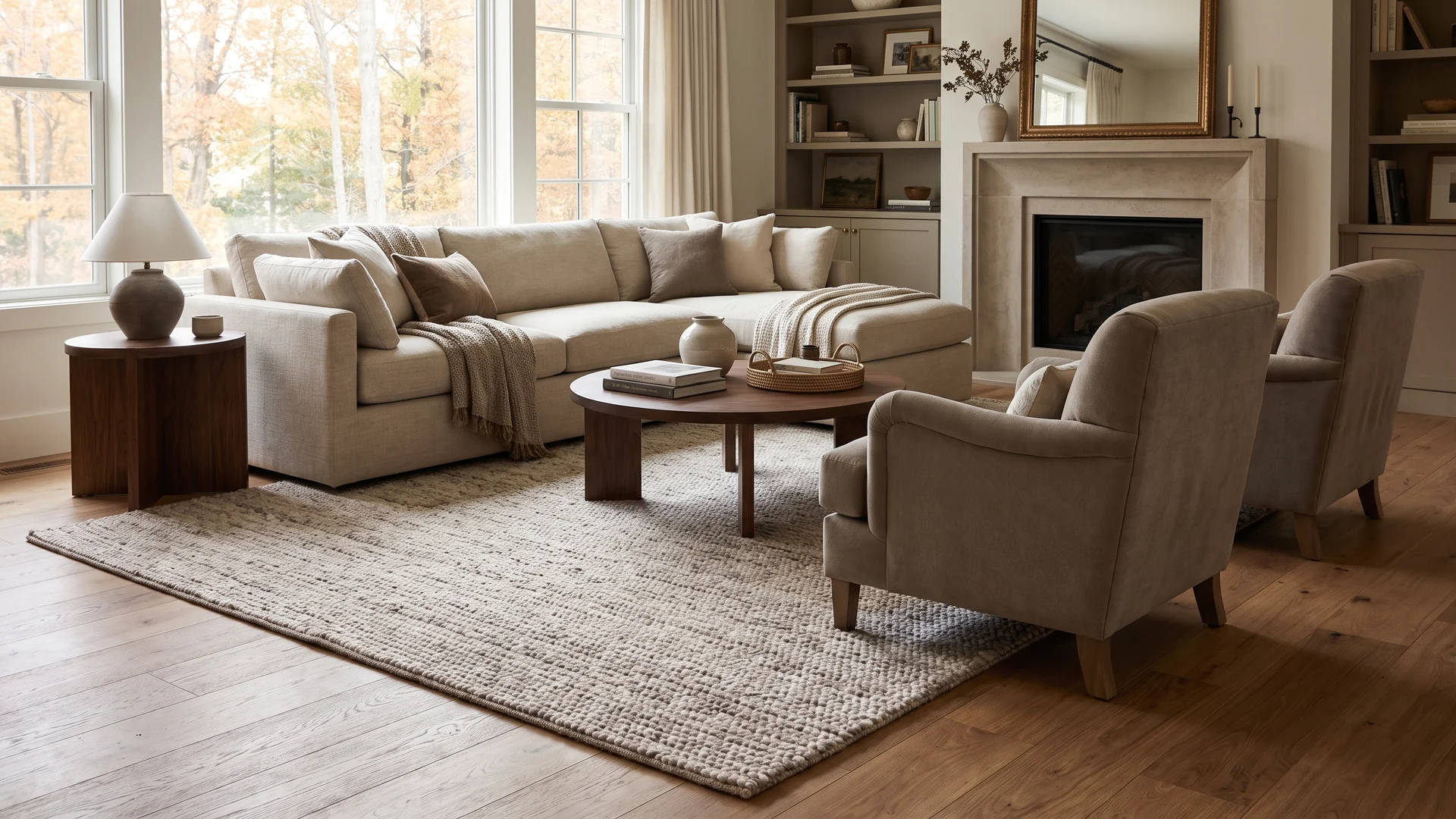
What the rug size calculator does
This calculator starts with the clear room dimensions and subtracts the floor border you want to leave visible around the rug. It then compares that usable footprint with common rectangular rug sizes and suggests the largest standard option that fits. This is useful when you want a room-wide rug without running the edges into walls, baseboards or door swings.
The result does not automatically determine the best furniture layout. A living-room rug, bedroom rug and dining rug can all use different rules even in rooms of similar size. Use the calculated maximum as a physical boundary, then decide how the furniture should relate to the rug.
Measure the usable floor area
Measure the room at floor level and note any built-ins, hearths, radiators or permanent cabinetry that reduce the usable rectangle. In an irregular room, focus on the zone the rug will actually occupy. A rug does not have to fill every corner of an L-shaped room; it should define the furniture group or functional area.
Also check doors. A thick rug can interfere with a low door sweep even when the rug footprint technically fits. If an entry door swings across the planned rug area, measure the clearance under the door or keep the rug outside the swing path.
Choosing the visible floor border
The clear-floor border is the distance between the rug edge and the surrounding walls or fixed boundaries. A larger border exposes more flooring and gives the rug a framed appearance. A smaller border creates a fuller, more luxurious floor covering but leaves less tolerance for imperfect room dimensions.
There is no universal correct border. In a compact room, a moderate border can make the rug feel generous without appearing wall-to-wall. In a large room, a very small rug surrounded by a huge border can look disconnected from the furniture. The calculator lets you test several values quickly.
Living room rug layouts
In a living room, the rug usually works best when it connects the seating. One common approach places the front legs of the sofa and chairs on the rug. A larger rug can hold all furniture legs, which often feels especially cohesive in a large room. A smaller floating rug that touches none of the main seating can make the group look fragmented unless the room is intentionally minimal and compact.
Measure the actual sofa and chair positions before buying. A rug that fits the room can still be too narrow to reach the front legs of a wide sectional. If you are still planning furniture, use painter's tape to mark the candidate rug size and then arrange the furniture around it.
Dining room rugs need chair clearance
A dining rug must remain under the chairs when diners pull them back. If the rug is only slightly larger than the tabletop, chair legs can catch the edge every time someone sits down. Measure the table and add enough extension around it for normal chair movement. Round tables can use round or square rugs, while rectangular tables typically pair naturally with rectangular rugs.
The room-size calculator can confirm the rug fits the room, but dining furniture should determine the minimum rug dimensions. Run both checks: first calculate the rug needed by the table and chairs, then make sure it fits inside the room with an appropriate floor border.
Bedroom rug planning
Bedrooms use rugs differently because the goal is often to provide a soft landing area around the bed. A large rug can extend under most of the bed and project on both sides and at the foot. A smaller rug may begin under the lower two-thirds of the bed, leaving the nightstands directly on the floor.
For bed-specific planning, use the Bed & Rug Size Planner. It works from mattress dimensions and desired extension rather than the full room. The room rug calculator is still useful as a second check to make sure the suggested bed rug is not too large for the available floor.
Common rug sizes are nominal
Retail rug dimensions are often approximate. A rug labeled 8 × 10 feet may vary slightly, and handmade rugs can vary even more. Always check the product's actual dimensions when fitting a tight space. The calculator works with standard nominal sizes, so allow a little tolerance near walls and furniture.
Pattern direction also matters. A strong border or medallion can make a rug feel visually smaller because the active central field is reduced. A plain or low-contrast rug can feel larger and quieter at the same physical dimensions.
Worked example
Suppose a room is 5 meters long and 4 meters wide and you want about 45 centimeters of visible floor around the rug. Subtracting that border from both sides leaves a maximum footprint near 4.1 by 3.1 meters. The calculator checks common sizes that fit inside that envelope and recommends the largest suitable option.
You might still choose a smaller rug if the furniture group occupies only one end of the room. The largest fitting rug is a boundary, not an instruction to cover every available centimeter.
Rug sizing mistakes to avoid
- Buying from room dimensions without considering furniture placement.
- Using a dining rug that is too small for pulled-out chairs.
- Ignoring door swings and low clearances.
- Assuming a nominal rug size is exact.
- Choosing a tiny rug solely to expose more flooring.
- Forgetting that thick pads add height at thresholds.
Rug size calculator FAQs
Should a living-room rug go under the sofa?
Often at least the front sofa legs sit on the rug, but all-legs-on layouts can work in larger rooms. The furniture group should look connected.
How much floor should show around a rug?
There is no fixed rule. Enter different borders and compare the resulting sizes with your furniture plan.
Can a rug be too large?
Yes. If it crowds walls, blocks doors or makes a room feel nearly carpeted when that is not the intention, a smaller size can be better.
Related tools: Bed & Rug Size Planner, Sofa Size Calculator and Room Area Calculator.