
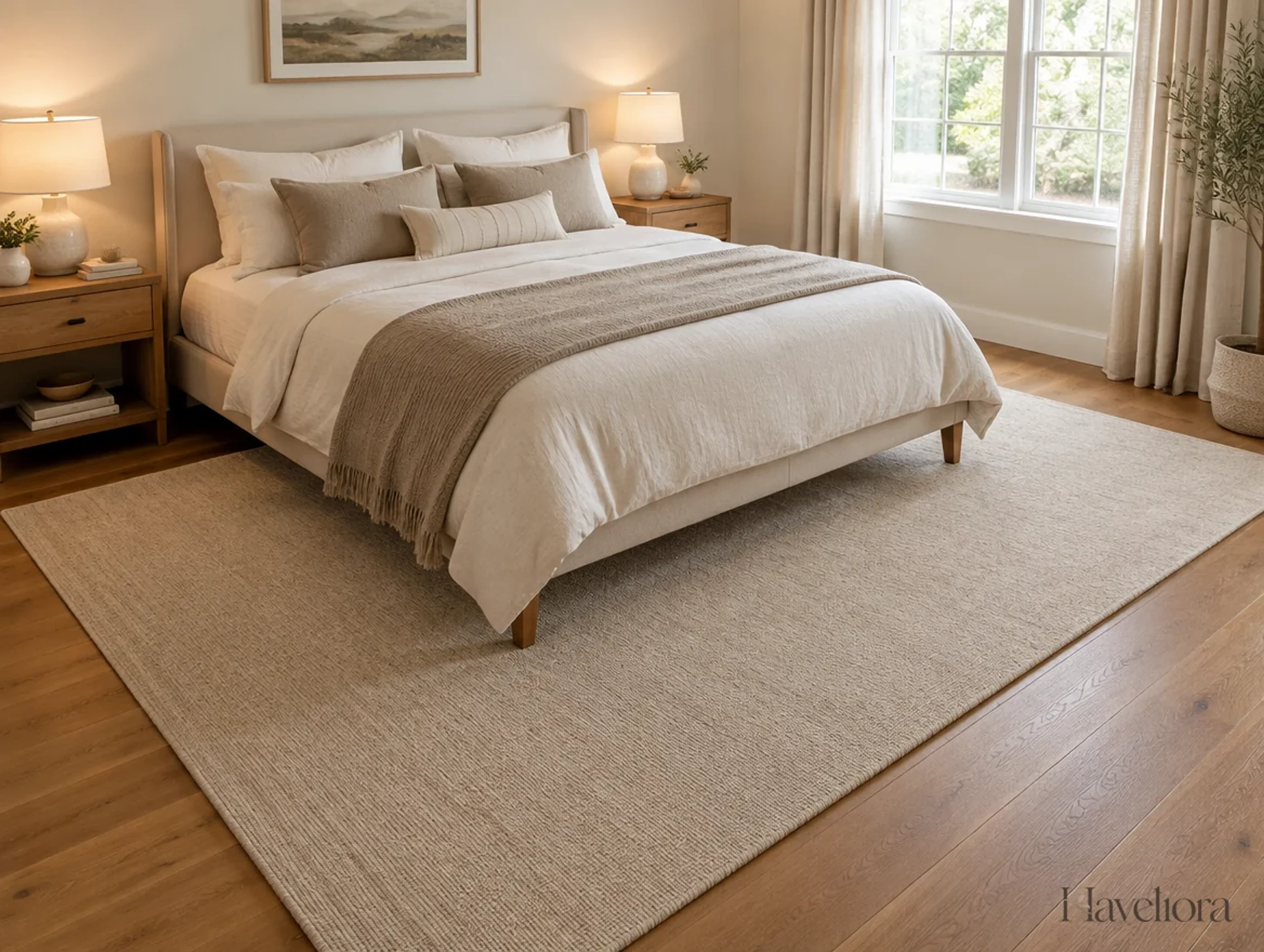
How the bed and rug size planner works
The planner starts with a standard mattress footprint and adds the amount of rug you want visible on each side and at the foot. It produces a minimum rug footprint, then compares that footprint with common rug sizes. This is more useful than choosing a rug from bedroom dimensions alone because the bed is the central object the rug must relate to.
The calculator assumes the rug begins near the head of the bed. If you plan to place only the lower two-thirds of the bed on the rug, the required rug length can be smaller. Use the result as a full-coverage reference and adjust for the specific layout.
Why side extension matters
The visible rug beside the mattress creates the soft landing zone for your feet. If only a few centimeters show, the rug can look undersized and provide little practical comfort. More extension feels generous and visually anchors the bed, but it requires enough room between the bed and walls or other furniture.
Choose the extension based on the room rather than a universal rule. A compact bedroom may need a tighter margin, while a large room can support a wider border of rug around the bed.
Extension at the foot of the bed
Rug beyond the foot helps the bed feel fully grounded and can provide space for a bench. If a bench sits at the foot, decide whether its legs should remain on the rug. A longer rug may be necessary to keep the bench connected to the composition.
In a narrow bedroom where the foot of the bed is close to a wall or dresser, excessive rug extension can interfere with circulation. Measure the remaining walkway before increasing the rug length.
Queen, king and other bed sizes
Bed names are convenient, but exact mattress dimensions vary slightly by market and manufacturer. The planner includes common dimensions for twin, full, queen, king and California king sizes. If your mattress differs, use the closest result as a guide and compare the rug footprint manually with the actual bed measurements.
Remember that the bed frame can be wider and longer than the mattress. Upholstered frames, platform edges and footboards can add several centimeters. For a precise layout, mark the full bed-frame footprint on the floor rather than measuring only the mattress.
Should nightstands sit on the rug?
Both approaches can work. A very large rug can extend under the bed and nightstands, creating a unified zone. A slightly shorter rug can begin in front of the nightstands so they remain directly on the floor. The second arrangement often reduces the required rug length while still providing generous coverage beside the bed.
If the rug is thick, keeping nightstands off it can also prevent wobbling. The design decision should consider rug thickness, room size and whether the furniture legs sit evenly.
Lower-two-thirds rug placement
A popular alternative is to slide the rug under the lower portion of the bed rather than all the way toward the headboard. This puts more of the rug where people step and can work well when a full-length rug would collide with nightstands or wall space.
When using this layout, the side extension remains important but the required length changes. Mark the rug with painter's tape so you can see where the front edge will sit under the bed and where the foot edge will finish in the room.
Runners beside the bed
If a large rug does not fit the budget or room, two runners can create soft landing zones on each side. This approach works especially well when the bed nearly fills the room width or when an existing floor deserves to remain visible. The runners should be long enough to cover the main stepping area and positioned symmetrically when the room layout allows.
A single runner on the open side can also work in a bed pushed toward one wall. The planner is designed for one large rug, so runner layouts need separate measurements.
Worked example
A standard queen mattress is about 152 by 203 centimeters. If you want 50 centimeters of rug visible on each side and 60 centimeters beyond the foot, the minimum full footprint is about 252 centimeters wide and 263 centimeters long, depending on where the rug begins at the head. You would then compare that footprint with available common rug sizes.
If the room cannot accommodate that width while maintaining comfortable walkways, reduce the side extension or consider runners. Do not force a large rug simply because it is common under a queen bed.
Check the room after checking the bed
The bed-based result should be compared with the total room. The rug needs enough border from walls and should not block doors or bunch beneath heavy furniture unexpectedly. Use the separate Rug Size Calculator to check the room-wide fit if the bedroom is tight.
Rug thickness also matters at closet doors and low-clearance furniture. A plush rug and pad can add noticeable height near sliding or hinged doors.
Bed and rug planning mistakes
- Choosing a rug from bed name alone without checking actual frame dimensions.
- Leaving so little rug visible that the bed overwhelms it.
- Ignoring a bench or dresser at the foot of the bed.
- Forgetting room walkways while maximizing rug extension.
- Letting only two legs of a nightstand sit on a thick rug, causing wobble.
- Buying before marking the footprint on the floor.
Bed and rug FAQs
Does the rug need to go under the nightstands?
No. It can stop in front of them or extend underneath, depending on room size and the look you want.
Can I use a smaller rug under a king bed?
Yes, particularly with a lower-two-thirds layout, but make sure enough rug remains visible on both sides to look intentional.
Are standard rug sizes exact?
Not always. Check the retailer's actual dimensions before purchasing, especially in a tight bedroom.
Related tools: Rug Size Calculator, Room Area Calculator and Sofa Size Calculator.