
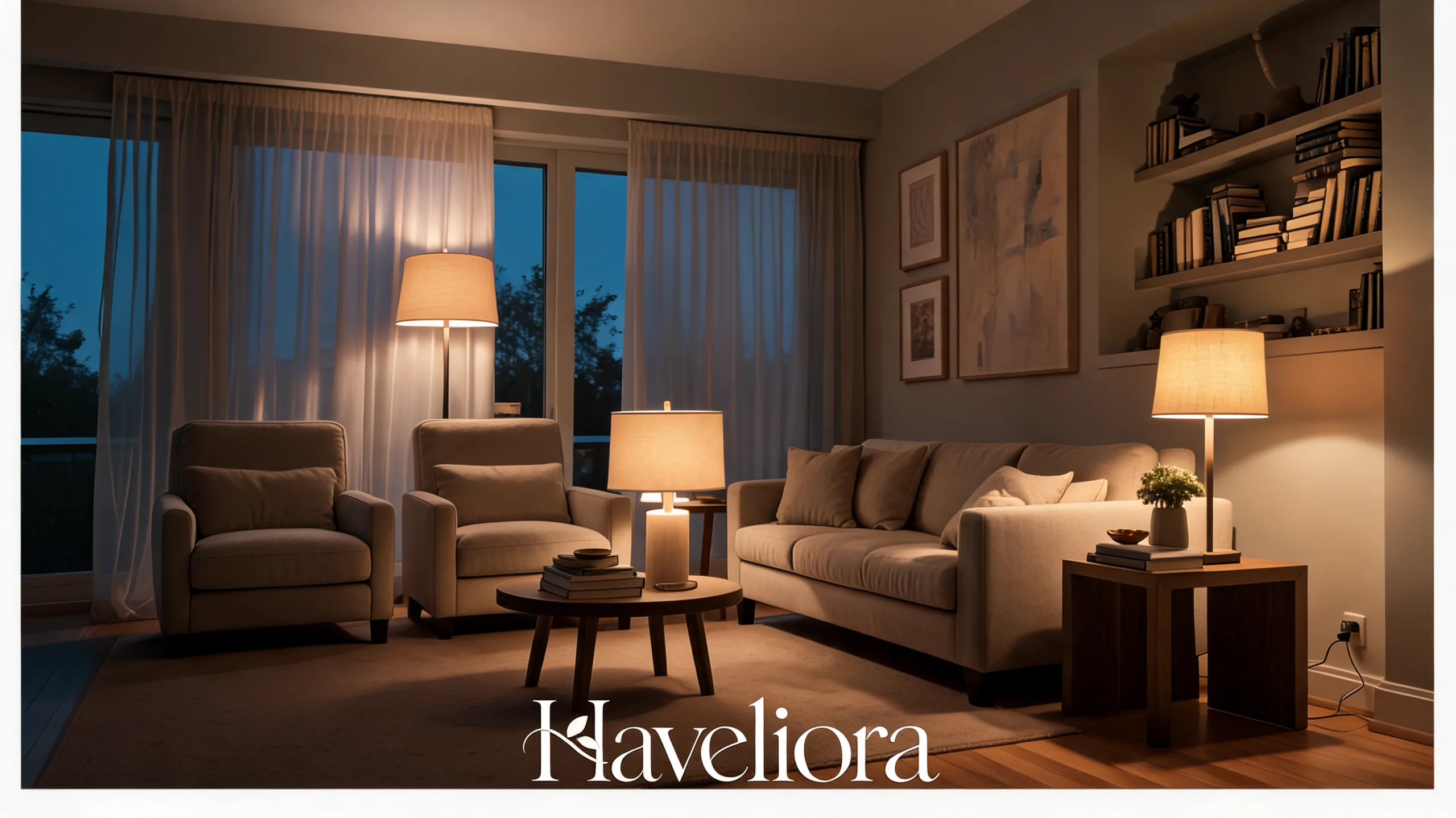
What the lighting calculator estimates
The calculator multiplies floor area by a target illuminance in lux to estimate how many lumens should reach the room for general planning. It then divides that total by the lumens you enter for one bulb to give an approximate bulb count. This is a quick way to compare lighting levels and fixture output before purchasing lamps or ceiling fittings.
The result is not a professional lighting design. Real illumination depends on fixture efficiency, beam direction, ceiling height, wall color, daylight, shades and the distribution of light. Use the output as a target to divide among several fixtures rather than assuming every lumen must come from identical bulbs.
Lux and lumens are different
Lumens describe how much visible light a lamp or fixture produces. Lux describes how much light reaches a surface: one lux is one lumen per square meter. A small room can reach the same lux with fewer lumens than a large room because the light is distributed across less area.
This is why “how many watts?” is not the best starting question for modern LED lighting. Wattage tells you energy consumption, while lumens are a better comparison for light output.
Choose a target brightness for the activity
Soft ambient rooms need less illumination than kitchens, desks or craft areas where detailed tasks take place. The calculator includes several target levels so you can see how dramatically the requirement changes. A bedroom may feel comfortable at a lower general level, while a kitchen benefits from brighter task zones.
Do not necessarily light the whole room to the highest task level. Layered lighting is more flexible. General ambient light can be moderate while under-cabinet lighting, desk lamps or reading lights provide stronger illumination exactly where it is needed.
Why layered lighting usually works better
A well-lit room commonly combines ambient, task and accent lighting. Ambient light provides overall visibility. Task lighting supports activities such as reading, chopping food or working. Accent lighting highlights art, texture or architecture. Dividing the lumen target among these layers produces a more comfortable and visually interesting room than relying on one intense central fixture.
For example, a living room may use a ceiling fixture for part of the total, table lamps near seating, a floor lamp for reading and a picture light over art. The mathematical total is only the starting point; the locations and direction of those lumens shape the experience.
Ceiling height and dark surfaces affect results
A high ceiling increases the distance between ceiling fixtures and working surfaces, so more output or more focused optics may be needed. Dark walls, ceilings and furnishings absorb more light than pale reflective surfaces. A room painted deep green can feel dimmer than a white room using the same fixtures.
The calculator does not automatically adjust for reflectance or mounting height. If your room is unusually tall or dark, use the result as the lower planning reference and compare real fixture photometric data where available.
Bulb count is only an approximation
Dividing total lumens by one bulb's output gives a simple count, but fixtures do not distribute all light equally. A bare bulb, frosted globe, shaded lamp and recessed downlight can each deliver a different amount of useful light to the room even when the lamp lumen rating is identical.
If the fixture uses integrated LEDs, compare the entire fixture's lumen output rather than trying to convert it into a bulb count. For a chandelier with several lamps, add the lumens of all lamps together.
Color temperature and color rendering
Brightness is not the only quality that affects how a room feels. Color temperature describes whether the light appears warmer or cooler. Many homes use warm light in bedrooms and living rooms and slightly cooler or neutral light in task areas, although personal preference varies.
Color rendering describes how accurately colors appear under the light. Good color rendering is useful in kitchens, dressing areas, bathrooms and rooms where fabrics, art or finishes matter. These factors do not change the lumen calculation but can strongly influence satisfaction with the finished lighting.
Worked example
A 5-by-4-meter living room has 20 square meters of floor area. At a target of 200 lux, the simple calculation is 4,000 lumens. If each lamp produces 800 lumens, the mathematical count is five lamps. You might provide those lumens with one ceiling fixture and several portable lamps rather than five identical ceiling bulbs.
If the same room is used for detailed tasks at a 300-lux target, the calculation rises to 6,000 lumens. Instead of making the entire room uniformly brighter, adding focused task lights can often produce a more comfortable result.
Lighting planning mistakes to avoid
- Comparing bulbs only by watts instead of lumens.
- Using one central fixture for every activity.
- Ignoring high ceilings and dark finishes.
- Choosing color temperature without considering room mood and finishes.
- Forgetting dimmers or multiple switching zones where flexibility matters.
- Installing task lighting behind the person, causing shadows on the work surface.
Lighting calculator FAQs
Does more lumens always mean better lighting?
No. Distribution, glare, contrast and control matter. Too much poorly directed light can be uncomfortable.
Can I calculate LED strips?
Yes if you know lumens per meter. Divide the required lumens by the strip's output per meter to estimate length, then check the manufacturer's installation limits.
Should I use the same lux in every room?
No. Match the target to the activity and use task lighting where higher levels are needed locally.
Related tools: Room Area Calculator, Ceiling Fan Size Calculator and Picture Hanging Height Calculator.