
Tools / Picture Hanging Height Calculator
Picture Hanging Height Calculator
Calculate the wall-hook or nail height for a framed picture using the frame height, the distance from the top of the frame to the taut wire or hanger, and your chosen artwork-center height.
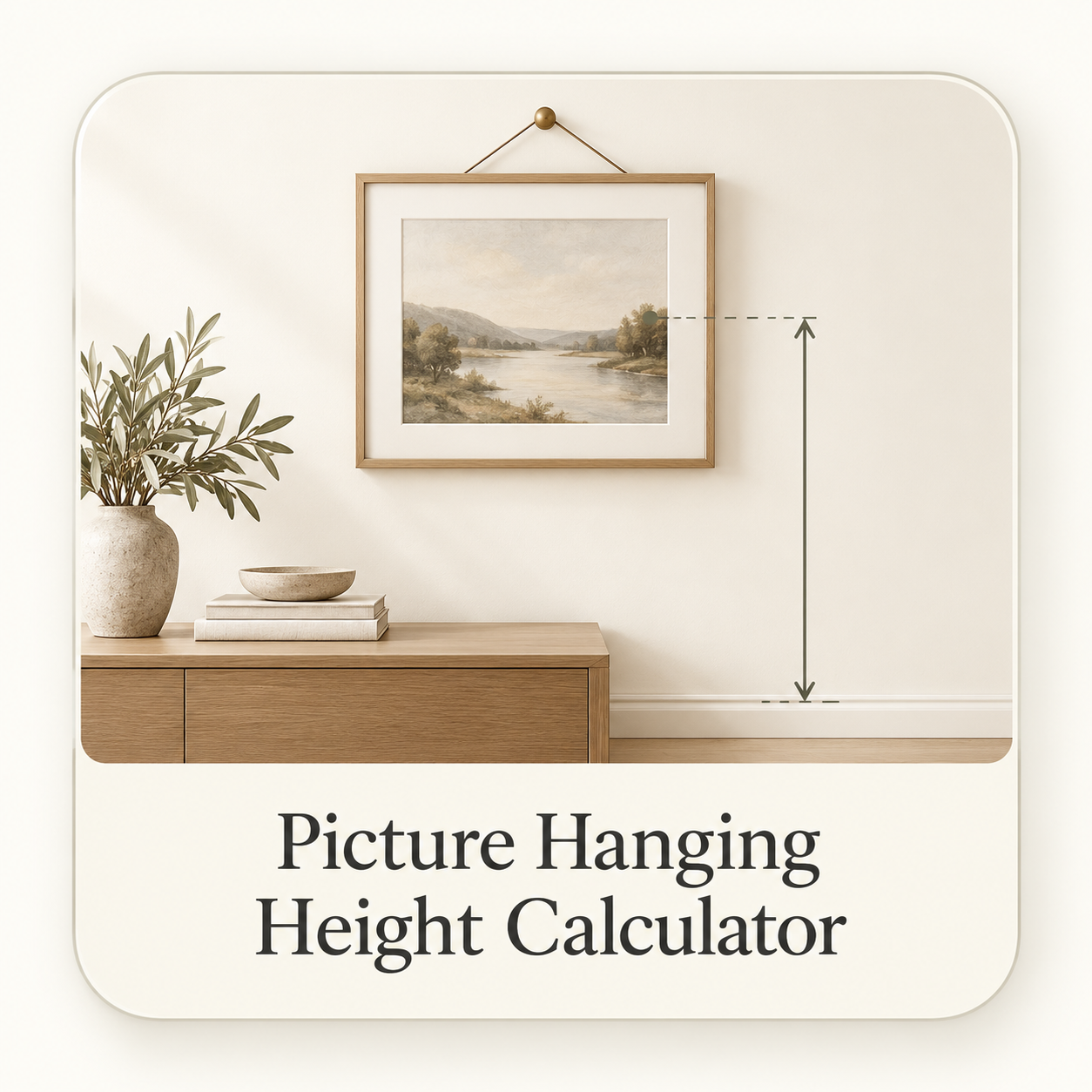
The simple formula behind picture hanging height
To center a picture at a chosen height, first determine where the top of the frame should land. The top edge equals the target center height plus half of the frame height. The hook then sits lower than that top edge by the distance from the frame top to the wire or hanging point. The calculator performs those steps automatically.
This is particularly useful with picture wire. If you simply mark the wall at the desired artwork center, the frame will hang too low because the wire drops below the frame top. Measuring the wire while it is pulled taut toward the hanging point makes the result much more reliable.
Choose the center height for the room, not a rule book
A commonly used gallery starting point is to place the center of art around standing eye level. Many homes use a center in the neighborhood of 145 to 152 centimeters, or roughly 57 to 60 inches, from the floor. That range is a useful reference, not a law. The right height depends on how the room is used and what sits beneath the art.
In a hallway, people usually view art while standing, so a conventional gallery center can work well. In a living room where everyone is seated, a slightly lower placement can feel more connected to the furniture. In a bedroom, artwork over a headboard is usually positioned by its relationship to the bed rather than by a standalone eye-level number.
Measure the hanging hardware correctly
For wire-hung art, pull the wire upward as it will sit on the hook and measure vertically from the top of the frame to the highest point of the taut wire. Do not measure the loose sagging wire. For D-rings, sawtooth hangers or fixed brackets, measure from the top edge of the frame to the exact point that will rest on the wall hardware.
If the frame uses two hooks, the vertical calculation is the same, but you also need the horizontal spacing between the hooks. Two-hook hanging can keep wide artwork level and reduce rotation. Use a level and confirm both wall marks before installing anchors.
Artwork above a sofa or console
When art hangs above furniture, the bottom edge and the furniture relationship become important. A piece can be mathematically centered at gallery height yet still look as if it floats too far above the sofa. Before finalizing the center height, calculate the bottom edge and compare the gap with the top of the furniture.
Large art often looks stronger when it feels visually connected to the object below it. That may mean raising or lowering the center from the default gallery reference. Use the calculator iteratively: adjust the target center until the bottom edge creates the relationship you want, then use the resulting hook height for the wall mark.
Large artwork needs a proportion check
Height is only one part of hanging art well. Width matters too. A very narrow picture over a wide sofa can feel undersized even if it is placed at the correct height. Conversely, an oversized work may dominate a small wall. Before drilling, compare the artwork width with the furniture and available wall zone.
When a picture is extremely tall, centering it at a conventional eye-level height can bring the bottom edge very low. In that case, the architecture and furniture should guide the final placement. The calculator gives you the exact geometry so you can make that choice knowingly.
How to mark the wall with fewer mistakes
Once you have the hook height, measure upward from the finished floor at the exact horizontal position where the picture will hang. Make a light pencil mark. If the frame uses a single hook, install the hook at that mark. If it uses two hooks, mark the center line first, then measure half the hook spacing to each side.
Before drilling into tile, masonry or walls with hidden services, confirm the installation method and what may be behind the surface. In drywall, the artwork weight and stud location determine whether a simple picture hook is sufficient or an anchor is needed.
Paper templates are useful for groups
For two or more pictures, calculate the group first rather than hanging each piece in isolation. Trace each frame onto paper, cut the shapes out and tape them to the wall. This lets you test the center line, spacing and relationship to nearby furniture without making holes.
Once the paper arrangement looks right, mark the hook position for each frame on its paper template using the calculator. You can then transfer the marks to the wall systematically. This approach is especially effective for symmetrical grids and bedroom pairs.
Worked example
Suppose a frame is 60 centimeters tall, the taut wire sits 8 centimeters below the top edge, and you want the picture center at 145 centimeters. Half the frame height is 30 centimeters, so the top edge should land at 175 centimeters. Subtract the 8-centimeter wire drop and the hook mark becomes 167 centimeters from the floor.
The same geometry works in inches. If a 24-inch frame is centered at 58 inches and the hanger point sits 3 inches below the top, the top edge is 70 inches and the hook is 67 inches from the floor.
Common picture-hanging mistakes
- Measuring a loose wire instead of pulling it taut.
- Using the top of the frame as the hook height.
- Following a generic eye-level rule without checking furniture below.
- Hanging a group piece by piece instead of positioning the group as one composition.
- Using hardware that is not rated for the artwork weight.
- Skipping a level check when using two hooks.
Picture hanging FAQs
What center height should I enter?
Use a gallery-style eye-level height as a starting point, then adjust for seated rooms, very tall art or furniture below. The calculator is intentionally flexible so the geometry does not force a design rule.
What if my frame has D-rings instead of wire?
Measure from the top of the frame to the point on the D-ring where the wall hook will sit. Enter that as the drop measurement.
Can I use this for a gallery wall?
Yes for each individual hook height, but plan the overall group first. The Haveliora Gallery Wall Calculator can help estimate the group footprint and grid.
Related tools: Gallery Wall Calculator, Room Area Calculator and all Haveliora tools.