
Tools / Ceiling Fan Size Calculator
Ceiling Fan Size Calculator
Estimate a practical ceiling-fan blade span from room area, then check whether the ceiling height suggests a flush mount, standard downrod or longer drop. This is a room-planning guide for shopping and layout decisions.
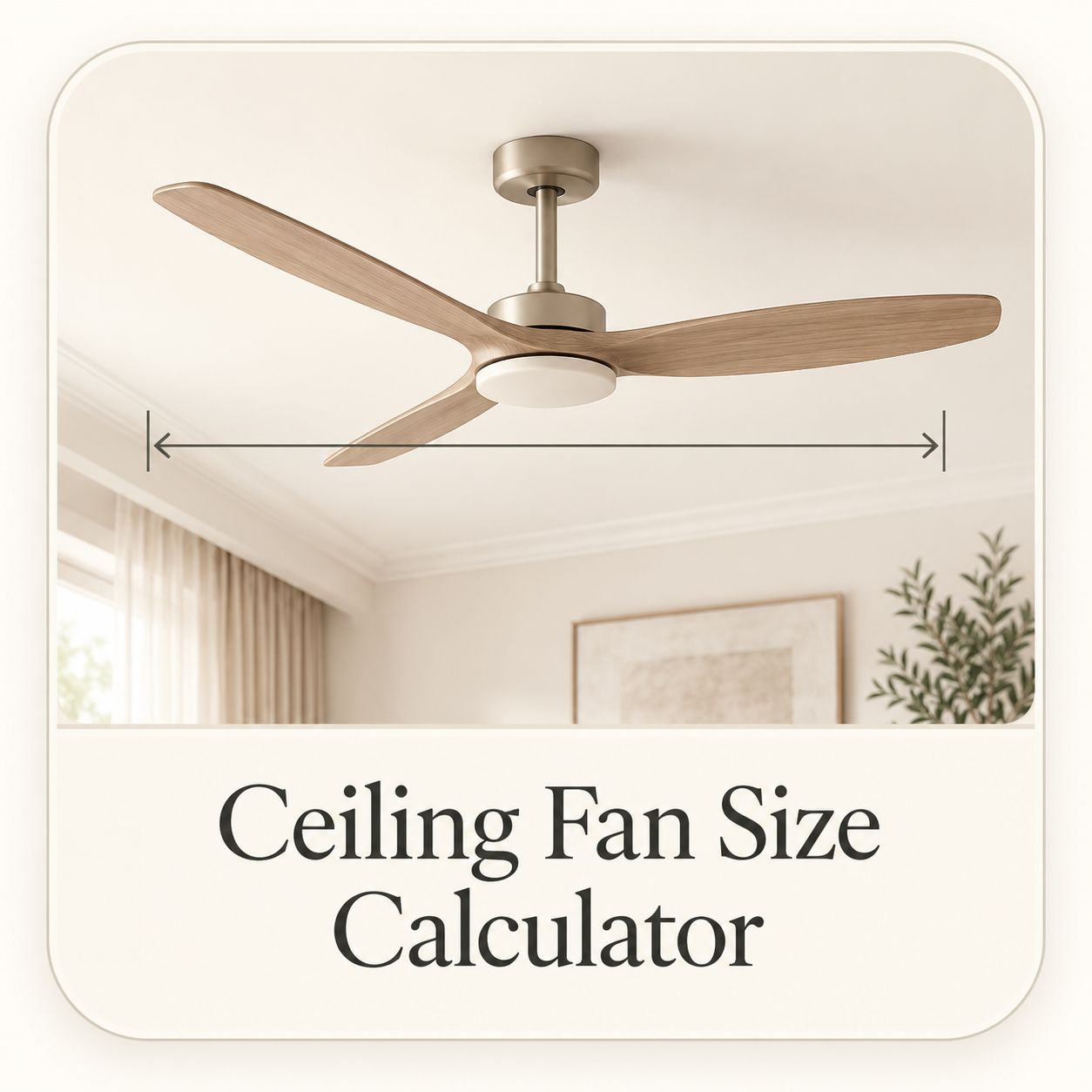
What the ceiling fan size calculator does
The calculator converts the room to square feet and places it in a practical blade-span band. Smaller rooms usually need a smaller fan, while larger living rooms and open spaces often benefit from a wider blade span or more than one fan. The result is intentionally a range rather than a single guaranteed model because two fans with the same diameter can produce very different airflow.
It also looks at ceiling height and gives a mounting-style note. This helps you narrow the shopping list before comparing real products. The final installation must follow the fan manufacturer’s clearance, electrical and mounting instructions, especially on sloped ceilings or when the blades will be close to tall furniture or built-ins.
Why room area is the first sizing check
A ceiling fan circulates air across a floor area rather than cooling the air like an air conditioner. If the fan is too small for the room, air movement can feel weak at the seating areas. If the fan is oversized for a compact room, the visual scale may feel heavy and the airflow may be stronger than you want at normal speed. Room area gives a quick way to avoid those extremes.
The calculator multiplies room length by width, then compares the result with commonly used residential fan-size bands. This is a screening method, not a mechanical-engineering calculation. Airflow rating in cubic feet per minute, motor design, blade pitch and speed settings remain important when comparing actual products.
Blade span is not the same as airflow
Blade span is the diameter from the tip of one blade to the tip of the opposite blade. It is easy to compare because manufacturers list it prominently, but it does not tell the whole performance story. A well-designed 52-inch fan can move more air than a decorative 60-inch fan with a weaker motor or less efficient blade geometry.
After using the calculator, compare the manufacturer’s airflow data, energy use and noise information. A bedroom may prioritize quiet low-speed operation, while a large family room may prioritize higher airflow. Outdoor covered areas require a fan rated for the exposure conditions, which is a separate requirement from size.
How ceiling height changes mounting style
On a lower ceiling, a flush or low-profile fan may be appropriate because a long downrod would bring the blades too close to people. On a standard ceiling, the manufacturer’s included downrod often creates a comfortable hanging position. Taller ceilings can need a longer downrod so the fan is not trapped high above the occupied zone where its air movement feels less effective.
The calculator provides a general note based on ceiling height, but it cannot know the height of the fan motor housing or the exact blade position. Two models with the same downrod can hang at different final heights. Read the product’s assembled-height diagram before ordering.
Long and open-plan rooms may need two fans
A single wide fan does not always distribute air evenly in a long rectangular room. If the space extends well beyond the fan’s effective area, two medium fans can produce more balanced circulation and better visual rhythm. This is especially relevant in great rooms, combined kitchen-living spaces and long covered porches.
If you are considering two fans, divide the room into two approximate zones and run the calculator for each zone rather than simply choosing the largest possible fan. The fans should also be spaced so the blade circles do not conflict and the airflow patterns remain useful.
Bedrooms, living rooms and kitchens need different priorities
In a bedroom, quiet operation and a gentle low-speed setting can matter more than maximum airflow. A visually lighter fan may also feel more appropriate above a bed. In a living room, scale and appearance usually play a larger role because the fan is often visible from multiple angles. In a kitchen or breakfast area, consider lighting, cabinet doors and whether the fan will move lightweight papers or affect cooking smoke patterns.
The size calculator cannot make those style decisions, but it can keep them within a sensible physical range. Once you have a blade-span band, compare finishes, light kits, controls and airflow data inside that band instead of browsing every fan size.
How to measure the room
Measure the floor dimensions of the area the fan is intended to serve. In an open-plan space, do not automatically use the entire floor plate if the fan is only meant for the seating zone. For a large open room, define the functional area first. If the ceiling is vaulted, record the height at the planned mounting point and check whether a sloped-ceiling adapter is required.
Measure before furniture arrives if possible, but keep the future layout in mind. A fan centered geometrically in the room may not be centered over the actual seating area. In some interiors, the better location is centered on the functional zone rather than the architectural rectangle.
Worked example
A 14-by-12-foot room has 168 square feet of floor area. That usually points toward a fan around the mid-40s to low-50s in blade span, depending on the product’s airflow and the room’s use. With a 9-foot ceiling, a standard mount or short downrod is often a sensible starting point, subject to the actual fan’s assembled height.
If the same room had a 12-foot ceiling, the blade-span recommendation would not change simply because the ceiling is taller, but the mounting strategy might. A longer downrod may place the blades at a more effective level. The final dimension must be checked against the manufacturer’s minimum clearances.
Common fan-sizing mistakes
- Choosing only by diameter and ignoring rated airflow.
- Using the whole open-plan floor area even though the fan serves only one zone.
- Ignoring final assembled height when selecting a downrod.
- Centering the fan on the room while the seating area is off-center.
- Using an indoor-rated fan in a damp or wet location.
- Assuming one huge fan is always better than two properly spaced fans.
Ceiling fan size FAQs
Is a bigger fan always better?
No. Oversizing can create excessive airflow, visual imbalance or clearance problems. Compare blade span and airflow together.
Can I use this tool for a vaulted ceiling?
You can use it for the room-area screen, but the downrod and mounting hardware must be selected for the actual slope and height using the manufacturer’s documentation.
Does the calculator replace an electrician?
No. It is a planning tool. Electrical box rating, wiring, support and code compliance require the proper installation method.
Related tools: Room Area Calculator, Lighting Calculator and all Haveliora tools.