
Tools / TV Mount Height Calculator
TV Mount Height Calculator
Estimate a comfortable TV center height, top edge and bottom edge before you drill. Enter your screen size and normal eye height; the tool uses a 16:9 screen shape and keeps the calculation focused on viewing comfort rather than the bracket itself.
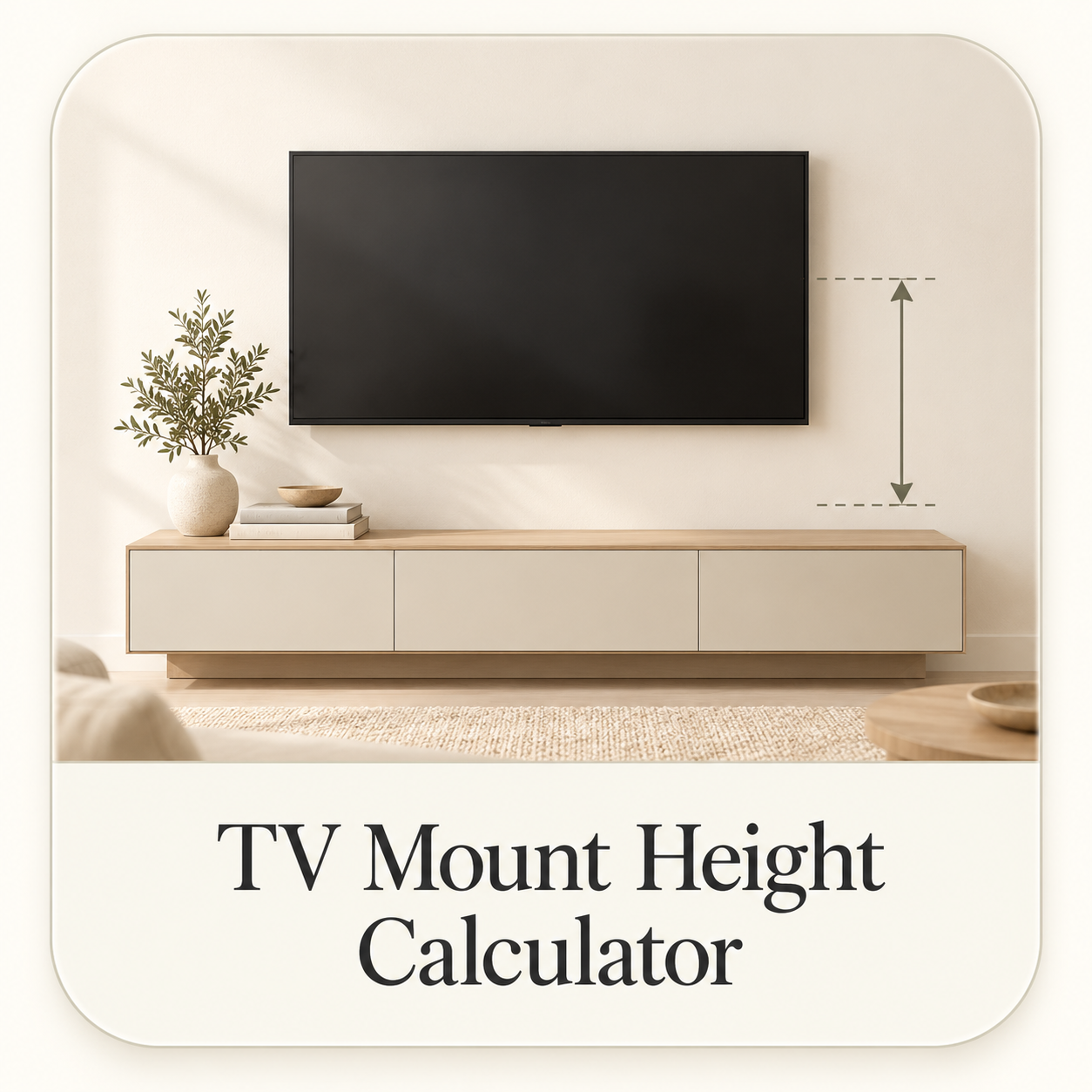
How to use the TV mount height calculator
Start with the television’s diagonal size, which is the number manufacturers use when they describe a 55-inch, 65-inch or 75-inch set. Then measure your normal seated eye height from the finished floor. Sit in the chair or sofa where you actually watch most often, keep your posture natural, and measure from the floor to your eyes. That measurement matters more than a generic “mount it this high” rule because sofas, recliners, beds and viewing postures are not all the same.
The default recommendation places the center of the screen at eye level. You can add a small positive offset if you deliberately prefer the screen slightly higher, such as in a bedroom or a room where the seating position is reclined. Treat the result as a planning target rather than a drilling measurement. The calculator can determine the screen’s center, top and bottom from the diagonal and aspect ratio, but it cannot know where the mounting holes sit on your exact television or how your bracket is constructed.
Why the center of the screen is the useful reference
A television is easier to position when you separate two different questions: where the screen should sit for comfortable viewing, and where the wall bracket must be attached. The first question is about the viewer; the second is about the hardware. Many installation mistakes happen when those two heights are treated as if they are identical. They rarely are.
The screen center is a stable visual reference because every 16:9 television has a predictable height for a given diagonal. Once the tool calculates the screen height, it can place half of that dimension above the center and half below it. The mounting plate, however, may sit above or below the television’s center depending on the VESA hole pattern, bracket arms and model-specific design. Always use the TV manual and bracket template to convert the recommended screen position into the final wall marks.
Measure your seated eye height correctly
Do not measure while standing and do not use the height of the sofa back. Sit where you normally watch, in the posture you normally use. If two people share the television, measuring both and using a sensible midpoint can be more practical than optimizing for one person. In a deep lounge sofa, the head may sit lower than expected. In a dining-kitchen room where people watch while standing, a slightly higher center can feel more natural.
For a bedroom, decide whether the television is primarily watched while sitting upright or lying back against pillows. Reclined viewing changes the line of sight. The offset field is intentionally manual so the calculator does not pretend that one bedroom angle fits every person. Make small changes and visualize the top and bottom edges before committing to holes in the wall.
Check furniture and soundbar clearance
After calculating the screen edges, compare the bottom-edge height with the top of your media console. Leave enough room for ventilation, cable access and any soundbar that will sit beneath the screen. A mathematically comfortable viewing height can still create a poor installation if the soundbar blocks the picture or the television nearly touches a tall cabinet.
Also consider how the furniture looks in elevation. A wall-mounted TV can appear disconnected from a low console if the gap becomes excessive. Conversely, pushing the screen down solely to make the wall composition look tighter can force viewers to look downward for long periods. Use the calculator result as the comfort anchor, then refine the composition within the limits of the actual room.
What screen dimensions the calculator assumes
The tool assumes a standard 16:9 television. It calculates screen height from the diagonal using the geometry of a 16:9 rectangle. Real televisions have bezels, and the outer cabinet can be slightly larger than the active picture area, so the top and bottom edge values are approximate if the manufacturer’s stated diagonal refers only to the display panel. For precise millimeter-level installation, check the product drawing for the total television height.
This distinction becomes more noticeable on very large screens. A small difference in bezel or chassis dimensions can move the outer edge by several millimeters or more. That rarely changes viewing comfort, but it can matter when fitting a television into cabinetry or close to a mantel.
Above-fireplace installations need extra checks
Mounting above a fireplace is not simply a height question. Heat, mantel depth, clearances and the fireplace manufacturer’s instructions can limit where a television can safely be placed. If those requirements force the screen well above your seated eye line, you may need a tilting or pull-down solution, or you may decide another wall gives a better viewing experience. This calculator does not override those safety requirements.
If the room layout leaves no alternative, calculate the comfortable target first so you can see how far the real installation deviates from it. That comparison is more useful than relying on a single universal height recommendation.
Common TV mounting mistakes
- Using standing eye level: most living-room viewing happens seated, so standing height can place the screen unnecessarily high.
- Marking the bracket at the recommended center: the bracket position depends on the TV’s VESA holes and the mount design.
- Ignoring the cabinet: check the screen bottom against consoles, center speakers and soundbars.
- Forgetting cable exits: confirm power and signal connections remain reachable after the television is mounted.
- Choosing height only for appearance: a balanced wall composition matters, but viewing comfort should remain the primary constraint.
Worked example: a 65-inch TV
Suppose your television is 65 inches and your seated eye height is 42 inches. A 16:9 65-inch screen is roughly 31.9 inches tall. If the center is placed at 42 inches, the bottom edge is about 26 inches from the floor and the top edge is about 58 inches. That does not mean the wall bracket should be fixed at 42 inches. Instead, hold the television’s desired center at that level, then use the hardware template to determine the mounting plate position.
If your media console is 24 inches high, the example leaves only a small gap under the television. You might raise the center slightly for a soundbar or choose a lower console. That is exactly why the edge values are useful: they expose conflicts before installation.
TV mount height FAQs
Should the middle of the TV always be at eye level?
Eye level is a strong starting point for seated living-room viewing, not an absolute rule. A modest upward adjustment can work in bedrooms, shared spaces or rooms with furniture constraints. The goal is a comfortable line of sight with no unnecessary neck strain.
Does TV size change the recommended center height?
The viewing center can stay at the same eye-level target, but a larger screen extends farther above and below that center. This is why a bigger television can collide with furniture even when its center remains comfortable.
Can I use the result to place the wall bracket?
Not directly. The result positions the screen. Measure the VESA holes and bracket geometry on your actual equipment to translate screen position into drilling marks.
Related Haveliora tools: TV Size Calculator, Room Area Calculator and all home planning calculators.